Key Takeaways: The headless CMS market is growing at a 22.6% CAGR, projected from $973M in 2025 to $7.1 billion by 2035. Headless load times are twice as fast as traditional CMS platforms, directly improving Core Web Vitals. 86% of headless CMS users report increased ROI . 61% of teams now use multiple CMS platforms seeking consolidation. Understanding headless CMS vs traditional CMS differences is now a business-critical decision, not a developer debate.
The CMS landscape has never been more consequential, or more confusing. WordPress powers 43% of all websites globally and still delivers excellent results for millions of businesses. But headless CMS platforms are growing at 22.6% annually, one of the fastest growth rates in enterprise software, because CMS website design, CMS website features, and CMS website templates built for single-channel delivery are increasingly inadequate for modern multi-platform content demands.
This guide breaks down headless CMS vs traditional CMS without the developer jargon, covering what is a headless CMS system, how headless CMS works, the real benefits of headless CMS , and how CMS website development services teams are making the right choice for clients in 2026.
What Is a Headless CMS System?
What is a headless CMS system? It’s a content management platform where the backend content repository is completely decoupled from the frontend presentation layer. In traditional CMS platforms, content creation and content display are tightly coupled, the CMS manages both what you write and how it appears to visitors. Traditional platforms offer CMS website design tools, pre-built CMS website templates, and CMS website features like WYSIWYG editors and plugin libraries, all in one system.
How does a headless CMS work? The content sits in the backend, accessed via APIs. The frontend, your website, mobile app, digital signage, or AR experience, calls those APIs to retrieve and display content independently. How does a headless CMS work in practice: one content entry published simultaneously to a website, iOS app, Android app, voice assistant, and smartwatch display, without duplicating content or rebuilding CMS website templates for each channel.
The name “headless” refers to removing the “head”, the frontend presentation layer, from the CMS body. Headless CMS architecture separates these two concerns entirely, giving development teams complete freedom over the frontend while editors manage content in a structured interface. Any business evaluating CMS vs headless CMS should understand this architectural distinction before making a platform decision.
How Does a Headless CMS Work vs. Traditional CMS ?
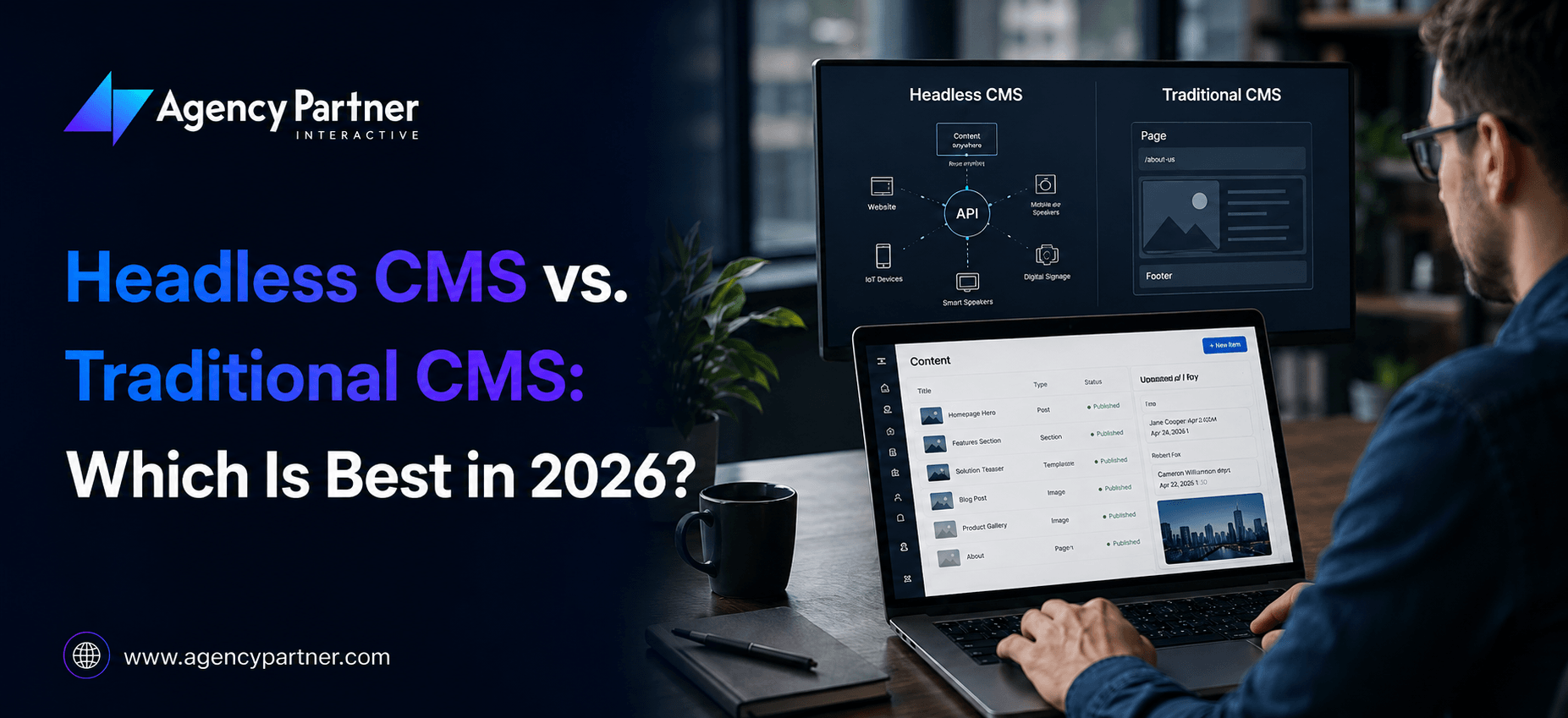
Understanding CMS vs headless CMS requires seeing both architectures side by side. Headless CMS vs traditional CMS is not just a technical comparison, it’s a strategic one.
Traditional CMS Architecture
In a traditional CMS , WordPress, Joomla, Drupal, content management and display are one system. CMS website features include built-in themes, CMS website templates, WYSIWYG editors, and plugin ecosystems. The CMS renders HTML pages server-side. A website template with CMS built in handles design automatically, which is why traditional platforms excel for teams without frontend developers. The CMS website design experience is all-in-one and accessible without coding.
Headless CMS Architecture
Headless CMS architecture separates the content backend from the frontend entirely. Developers retrieve content via API and render it using React, Next.js, Vue, or native mobile frameworks. No CMS website templates constrain the user experience. No website template with CMS limitations apply. CMS website design becomes entirely custom, which is the point. The tradeoff: higher development complexity vs. total frontend freedom.
| Traditional CMS | Headless CMS | |
|---|---|---|
| Frontend Control | Template/theme-based | Complete freedom |
| Content Delivery | Web only | Web, app, IoT, AR, voice |
| Speed | Server-side rendering | API-first, edge-optimized |
| Developer Flexibility | Plugin-limited | Any tech stack |
| Setup Complexity | Low | Medium to high |
| CMS Website Templates | Built-in | None — custom-built |
| Best For | Blogs, SMBs | Omnichannel, enterprise |
What Are the Benefits of Headless CMS in 2026?
The benefits of headless CMS are most visible in three areas: performance, flexibility, and omnichannel delivery.
Performance
Enterprises migrating to headless systems in 2026 report load times twice as fast as traditional monolithic platforms, directly improving Core Web Vitals and search rankings. Every one-second improvement in page load time correlates with a 2% increase in conversion rates. For high-traffic sites, the benefits of headless CMS on performance alone justify the investment.
Omnichannel Content Delivery
The single most compelling of all benefits of headless CMS : one content entry, infinite delivery channels. A single product description managed in a headless backend can populate a website, a mobile app, a voice assistant, digital in-store displays, and an AR shopping experience simultaneously, with no duplication. How headless CMS works for omnichannel is what makes it indispensable for enterprise retail, media, and digital product companies.
Developer Freedom
Headless CMS architecture imposes zero constraints on frontend technology. Teams choose the framework that best fits their use case, Next.js for SEO-critical marketing sites, React Native for mobile, custom builds for specialized applications. Traditional CMS website features and CMS website templates constrain what developers can build; headless architecture removes those constraints entirely.
AI and LLM Readiness
Structured content in headless systems, fields, blocks, components with defined relationships, is significantly easier for AI models to process than the mixed HTML/content of a traditional CMS page. In 2026, with AI content tools and LLM integration becoming central to CMS website development services, headless CMS architecture is the infrastructure built for that future.
ROI
86% of headless CMS users report increased ROI following migration. 69% report improved time-to-market and productivity. In Germany, 70% of companies experienced performance and scaling improvements after migrating to headless. The benefits of headless CMS aren’t theoretical, they’re documented across multiple markets and industries.
Why Use Headless CMS , and When Shouldn’t You?
Why use headless CMS comes down to your business context. The case is strong, but it’s not universal.
Why use headless CMS if you are:
- Building a website that must also power a mobile app, kiosk, or other digital touchpoint
- Running a high-traffic site where Core Web Vitals and speed matter for SEO
- Working with a development team comfortable with modern frontend frameworks
- Planning to integrate AI personalization, customer data platforms, or marketing automation
- Seeking omnichannel content delivery, the core of how headless CMS works at enterprise scale
When to stay with traditional CMS :
- You need fast deployment with minimal development resources
- Your editors need all-in-one CMS website design without managing a separate frontend
- You rely on CMS website templates and a website template with CMS for page-building
- Your site is primarily a blog or brochure site with no multi-channel requirements
- Your team doesn’t include frontend developers comfortable with React or Next.js
The CMS vs headless CMS decision is not about which is “better”, it’s about which matches your technical resources and growth trajectory. A solo blogger using WordPress with a website template with CMS built-in is making the right choice.
A global retailer deploying content to 12 channels needs headless CMS architecture. For CMS website development services providers advising clients, understanding this distinction is the difference between recommending the right platform and creating expensive technical debt.
What Are the Best Headless CMS Platforms in 2026?
The leading headless CMS architecture platforms each serve different organizational profiles:
Contentful
Enterprise market leader. The most mature headless CMS with the deepest integration ecosystem. Best for large organizations with dedicated development teams. A top choice for CMS website development services providers managing enterprise content at scale. Teams asking what is a headless CMS system capable of at enterprise level get their answer with Contentful.
Sanity
Best developer experience and real-time collaboration. Fully customizable content studio. Strong choice for teams prioritizing CMS website features alongside headless CMS architecture freedom. How does a headless CMS work at its most flexible? Sanity shows you.
Storyblok
Best for teams who want headless CMS architecture with a visual editor. Bridges the gap between developer freedom and marketer-friendly CMS website design. The strongest option when non-technical editors need to manage content independently — and the most compelling answer to “what is a headless CMS system that non-developers can actually use?”
Strapi
Open-source headless CMS with self-hosting option. Best for teams prioritizing cost control and full data ownership. Popular among CMS website development services teams building custom implementations. How headless CMS works with Strapi is entirely in the hands of the development team.
Prismic
Best for marketing teams building slice-based pages. Strong page-building experience alongside full headless CMS architecture flexibility. CMS vs headless CMS comparisons often reference Prismic as the closest headless equivalent to the editor experience of a traditional website template with CMS system, making the transition less jarring for content teams. CMS website features like visual layout editing, website template with CMS components, and structured content blocks are all native in Prismic’s slice model. How headless CMS works in Prismic is built around that familiar editing paradigm, making it the most accessible CMS vs headless CMS entry point for organizations migrating from WordPress or other traditional platforms.
Headless CMS vs Traditional CMS : The 2026 Verdict
Headless CMS vs traditional CMS in 2026 is less a technical debate and more a strategic one. The market data resolves the CMS vs headless CMS question clearly:
- Headless is growing at 22.6% CAGR, fastest in the CMS category
- Traditional CMS growth is flat or declining in enterprise
- 61% of teams use multiple CMS platforms seeking consolidation through modern headless
- Cloud CMS now represents 62.88% of new CMS deployments
For CMS website development services providers, headless is increasingly the default recommendation for any project with multi-channel requirements. CMS website features that once required a traditional CMS, visual editing, SEO tools, template management, are now native in headless platforms. CMS website design flexibility in modern headless tools has closed the gap significantly.
For businesses choosing between CMS vs headless CMS , the honest answer is: why use headless CMS if you’re a small business with a single website and a non-technical team? You probably don’t need it yet. Why use headless CMS if you’re managing content across web, app, and emerging channels with a dev team? You probably needed it last year.
The benefits of headless CMS compound over time, faster performance, lower technical debt, easier AI integration, and omnichannel readiness all build on each other. How headless CMS works in practice is that every content decision made in the backend becomes immediately available everywhere. How does a headless CMS work at scale means a single editor update appears simultaneously on your website, your app, your digital signage, and your voice interface, without a developer touching the frontend.
What is a headless CMS system doing that a traditional CMS can’t? Delivering that content without constraint. Headless CMS vs traditional CMS isn’t a question of which is technically superior in a vacuum. It’s a question of which serves your specific business model, your team’s capabilities, and your content strategy in 2026. And for a growing majority of businesses, how headless CMS works is exactly how they need content to work.
FAQs
What is a headless CMS system?
A content backend decoupled from the frontend, headless CMS system means content delivered via API to any channel independently without CMS website templates.
How does a headless CMS work?
How does a headless CMS work: editors manage structured content in the backend; developers retrieve it via API and render on any frontend framework. How headless CMS works eliminates CMS website design constraints entirely.
What are the benefits of headless CMS?
Faster load times, omnichannel delivery, complete frontend freedom, better AI integration, and documented ROI improvements vs. traditional CMS website features.
When should I choose headless CMS vs traditional CMS?
Choose headless for multi-channel, choose traditional when CMS website templates and website template with CMS simplicity suit your team.
Why use headless CMS over WordPress in 2026?
It can be used for omnichannel delivery, twice the load speed, no CMS website design constraints, and AI readiness that traditional CMS vs headless CMS architectures can’t match.
Planning a CMS migration or new web build? Agency Partner Interactive delivers CMS website development services across both traditional and headless architectures. How a headless CMS works for your specific use case, and whether a website template with CMS solution or a fully custom headless build is right for your team, is exactly the conversation we help clients navigate. Talk to our team.