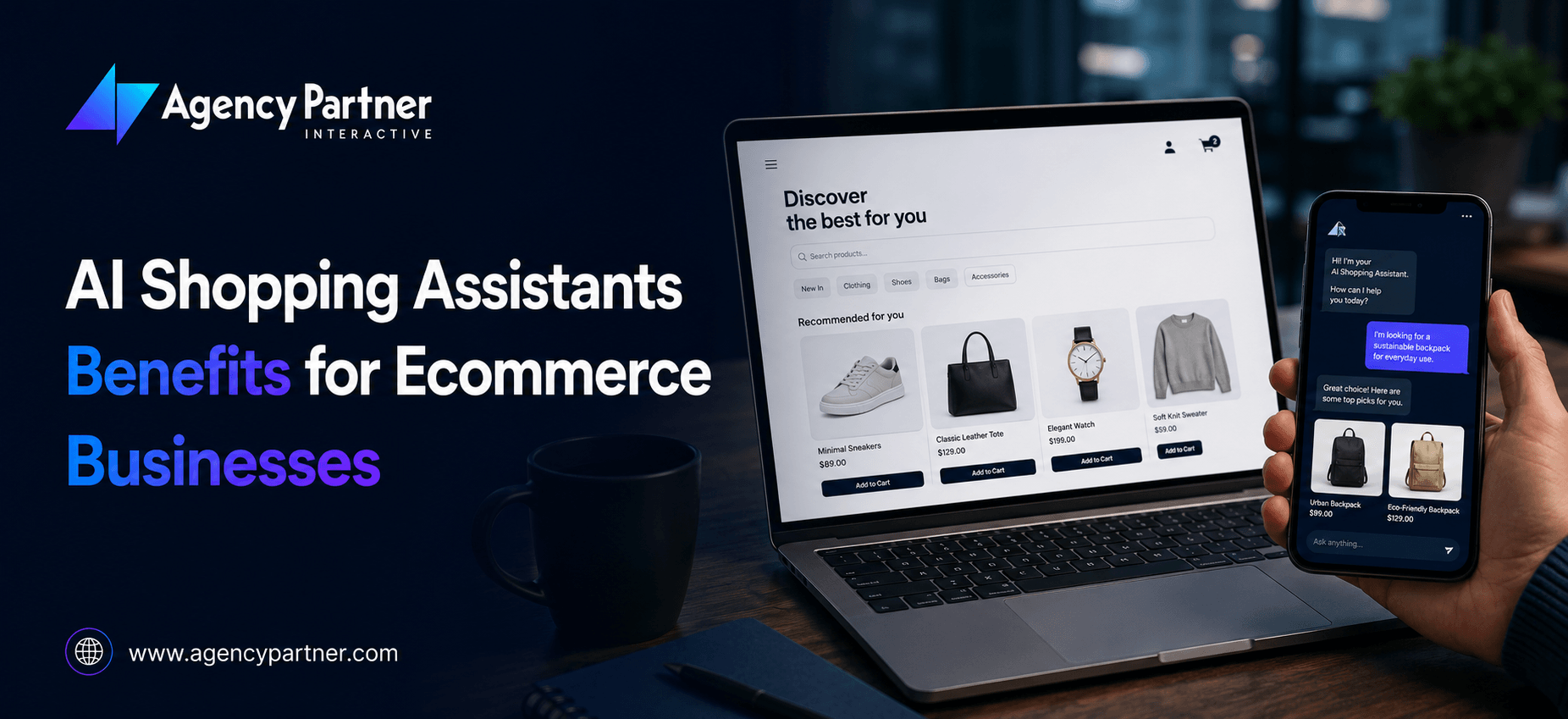
Key Takeaways: Shoppers who engage with an ai shopping assistant convert at 12.3% vs. 3.1% without AI, a 4x lift. Purchases are completed 47% faster with AI assistance. Adobe reports AI-driven traffic converts 42% more than non-AI traffic as of March 2026. 45% of shoppers engage when a virtual shopping assistant proactively greets them. Proactive ai powered shopping chat recovers approximately 35% of abandoned carts, the single highest-ROI automation available to e-commerce businesses today.
Most e-commerce stores convert between 2.5% and 3% of their visitors. That means 97 out of every 100 people who land on your site leave without buying.
An ai shopping assistant addresses that gap directly, not by pushing harder, but by doing what a great in-store sales associate does: understanding what the shopper needs, asking the right questions, and guiding them to the right product at the right moment. In 2026, the ai shopping system powering the best e-commerce experiences is conversational, personalized, and always available. The gap between stores using ai assistants for ecommerce and those that aren’t is already visible in the revenue data.
What Is a Digital Personal Shopper, and How Does It Work?
What is a digital personal shopper? It’s an AI-powered conversational agent that acts as a knowledgeable, always-available sales associate on your storefront. A digital shopping assistant listens to what shoppers describe, asks clarifying questions, understands natural language, and recommends products that match the specific need, not just keyword-matched catalog items.
What is a digital personal shopper in practice? When a visitor types “I need running shoes for flat feet that work on trails,” a personal shopping assistant powered by AI understands the use case, the constraint, and the channel, and surfaces the right product with relevant context. A standard search bar returns every shoe with “trail” in the description. A chatbot shopping assistant returns the right one.
Online shopping assistant tools in 2026 deploy across multiple channels: on-site chat widgets, SMS, email, social media DMs, and voice. An online shopping assistant sms channel, for example, lets customers continue browsing and purchasing conversations via text, meeting shoppers where they already communicate.
Benefit 1: How Does an AI Shopping Assistant Increase Conversion Rates?
This is the most documented ai shopping system benefit in 2026. Shoppers who engage with an ai shopping assistant during their session convert at 12.3%, nearly four times the 3.1% rate of shoppers who don’t. Adobe’s March 2026 data confirms: AI-driven traffic converted 42% more often than non-AI traffic, a complete reversal from just one year prior.
The mechanism is straightforward: friction kills conversions. A virtual shopping assistant removes friction at every point it appears:
- Visitors who can’t find what they need leave. A chatbot shopping assistant finds it for them.
- Shoppers uncertain about specs abandon carts. A personal shopping assistant validates their choice.
- First-time buyers hesitate. Ai powered shopping that explains sizing, compatibility, or use cases in real time closes the gap.
25% more likely to convert, that’s the documented lift when shoppers used an AI assistant vs. browsed independently across 3 million real shopper interactions. For a store doing $1M annually, that’s a measurable revenue impact from a single ai shopping system deployment.
Benefit 2: How Does a Virtual Shopping Assistant Reduce Cart Abandonment?
Cart abandonment sits at 70.19% globally, representing approximately $260 billion in recoverable revenue. Proactive ai powered shopping chat recovers approximately 35% of abandoned carts when triggered at exit intent or inactivity signals.
An online shopping assistant deployed at checkout can:
- Offer real-time assistance when a shopper pauses on a product page
- Surface customer reviews or size guides at the moment of hesitation
- Apply discount codes proactively for first-time buyers
- Recover abandoned sessions via online shopping assistant sms follow-up, meeting the shopper in their most responsive channel
The digital shopping assistant doesn’t just recover carts, it prevents abandonment in the first place by answering the questions that stall purchases before they become exits. 64% of AI-powered sales come from first-time shoppers, the most hesitation-prone segment and the one a personal shopping assistant serves best.
Benefit 3: Does an AI Shopping Assistant Speed Up the Purchase Journey?
Yes, significantly. Shoppers complete purchases 47% faster when assisted by a chatbot shopping assistant vs. browsing without assistance. Speed matters for two reasons: it reduces the window for second thoughts and abandonment, and it directly improves the mobile shopping experience, where attention spans are shortest.
Mobile conversion rates trail desktop by nearly half despite mobile accounting for 70% of e-commerce traffic. An ai shopping assistant optimized for mobile, fast-loading, conversational, requiring minimal typing, directly narrows that gap. The digital shopping assistant becomes the mobile experience rather than asking mobile shoppers to navigate desktop-designed catalog pages on a 6-inch screen.
Benefit 4: How Does AI Powered Shopping Drive Higher Average Order Value?
Ai powered shopping doesn’t just convert more visitors, it converts them to higher spend. Returning customers who use AI chat spend 25% more than those who don’t. AI-driven recommendation engines can increase average order value by up to 22%.
A virtual shopping assistant drives AOV through:
- Bundle recommendations: “Customers who bought this jacket also bought these gloves, they’re in your size.”
- Complementary product suggestions: surfaced contextually within the conversation, not as a generic widget
- Personalized upsells: based on the shopper’s stated use case, not just purchase history
Amazon’s recommendation engine, the original ai shopping system, drives 35% of annual sales. The same personalization capability is now accessible to independent e-commerce brands through ai assistants for ecommerce platforms without Amazon’s infrastructure budget.
Benefit 5: Can a ChatGPT Shopping Assistant Replace a Customer Support Team?
Not replace, but radically reduce the load. 93% of customer questions are now resolved by AI without human intervention. A chatgpt shopping assistant or LLM-powered online shopping assistant handles:
- Order status inquiries
- Return and exchange policy questions
- Size and fit guidance
- Shipping timelines
- Product compatibility questions
AI chat resolves queries up to 70% faster than traditional support channels. For e-commerce businesses where support costs scale directly with revenue, ai assistants for ecommerce break that equation, handling 10x the inquiry volume without adding headcount.
The most advanced implementations use a chatgpt shopping assistant architecture, an LLM connected to your product catalog, CRM, and order management system, that handles conversation context across sessions, recognizes returning customers, and personalizes responses based on purchase history.
Benefit 6: How Does a Personal Shopping Assistant Build Customer Loyalty?
Ai powered shopping compounds its value across the customer lifecycle, not just at the moment of first purchase. Returning customers using AI chat spend 25% more. AI personalization lifts customer retention by 10–15%. Customers engaging with personalized content show 70% higher conversion likelihood on repeat visits.
A personal shopping assistant builds loyalty by remembering, the shopper’s past purchases, stated preferences, size, and browsing patterns. Each return visit benefits from that accumulated context. The digital shopping assistant that helped a customer find the right gift in December uses that interaction history to surface relevant suggestions in February without requiring the customer to re-explain their needs.
This is what is a digital personal shopper doing that no static product page can: building a relationship over time that makes switching to a competitor increasingly costly.
Benefit 7: What Are the Omnichannel Capabilities of an AI Shopping System?
The most sophisticated AI shopping system in 2026 isn’t a single-channel widget, it’s an omnichannel presence that follows the shopper wherever they engage.
Ai assistants for ecommerce in 2026 operate across:
- On-site chat: proactive engagement, product discovery, checkout support
- Online shopping assistant sms: conversation recovery, order updates, re-engagement
- Email: AI-personalized product recommendations and abandoned cart sequences
- Social DMs: Instagram and Facebook Messenger shopping conversations
- Voice: integration with Alexa, Google Assistant, and in-store kiosks
An online shopping assistant sms channel is particularly high-performing for cart recovery, SMS open rates sit at 98% compared to 20–22% for email. A shopper who abandons a cart can receive a personalized recovery message via text within minutes, with the chatbot shopping assistant continuing the conversation in the channel the customer actually reads.
Benefit 8: What Is the ROI of an AI Shopping Assistant for E-Commerce?
The ROI case for ai assistants for ecommerce is the strongest in the technology stack for most e-commerce businesses. Summarizing the data:
- 4x higher conversion rate for AI-engaged shoppers (12.3% vs. 3.1%)
- 47% faster purchase completion
- 35% abandoned cart recovery rate via proactive chat
- 25% higher spend from returning AI-assisted customers
- 93% of support queries resolved without human escalation
- 42% higher conversion from AI-referred traffic
- Retailers using AI saw 14.2% sales growth vs. 6.9% for non-AI retailers
BigCommerce documents a 30% ROI from virtual shopping assistant initiatives, driven by higher order frequency and more effective promotions. McKinsey benchmarks AI personalization at a 5–15% revenue lift, with top performers reaching 25%.
The question for most e-commerce businesses isn’t whether a digital shopping assistant delivers ROI. It’s which deployment, on-site chatbot shopping assistant, online shopping assistant sms, or full omnichannel ai shopping system, fits their customer journey and technical infrastructure.
FAQs
What is a digital personal shopper?
An AI-powered assistant that understands shopper needs, asks clarifying questions, and recommends the right product conversationally in real time.
How does an AI shopping assistant increase conversions?
By removing friction, answering questions, validating choices, and guiding hesitant buyers. AI-engaged shoppers convert at 12.3% vs. 3.1%.
What is an online shopping assistant SMS channel?
A text-based shopping assistant that continues product conversations and cart recovery via SMS, with 98% open rates vs. 20% for email.
Can a ChatGPT shopping assistant replace customer support?
Not entirely, but it resolves 93% of queries without human help, handling volume that would otherwise require significant support headcount.
What AI shopping system should my ecommerce store use?
Depends on scale and channels. Start with on-site chat, then expand to SMS and social DMs as you optimize the core conversion flow.
Ready to add an AI shopping assistant to your e-commerce store? Agency Partner Interactive designs and integrates AI-powered shopping experiences that convert browsers into buyers.