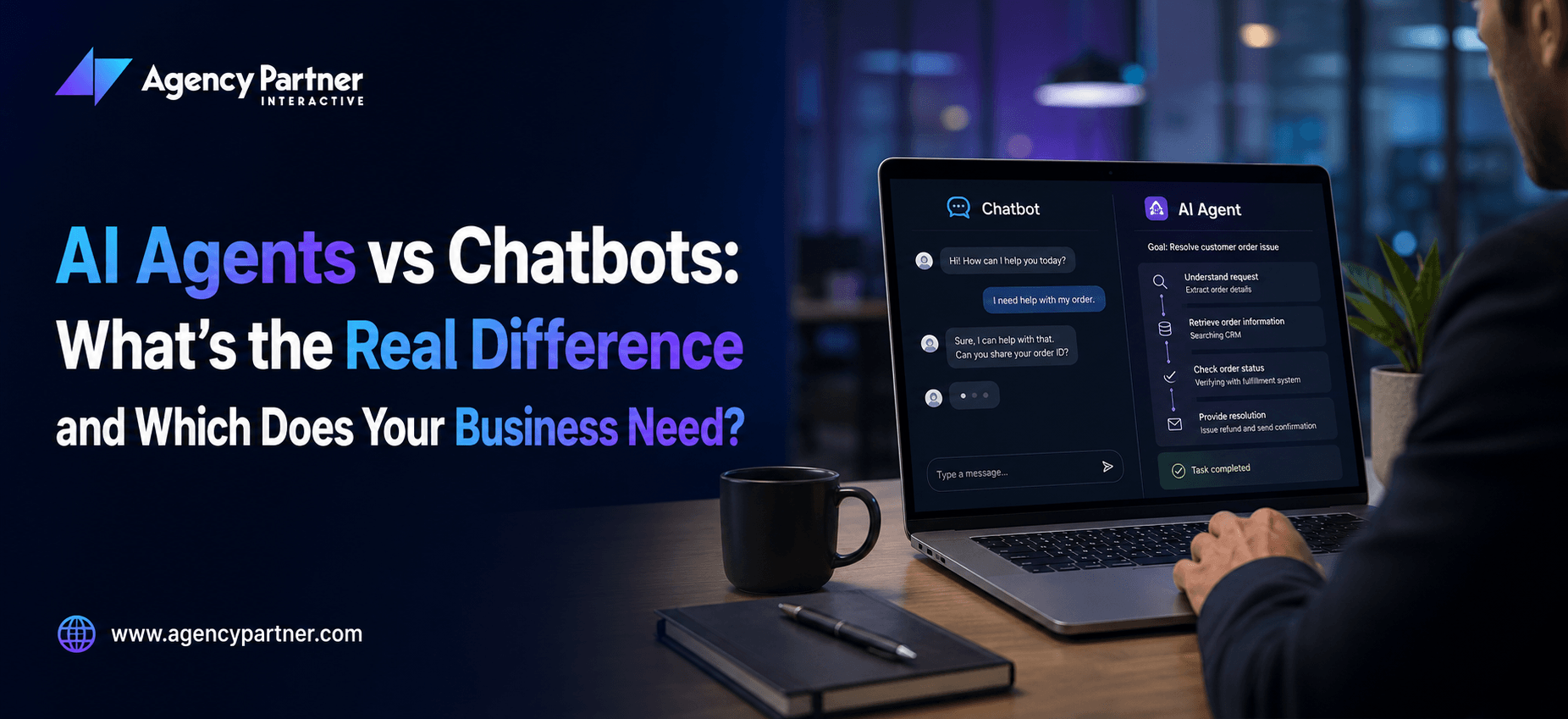
Your vendor says you’re buying AI. What you probably got is a chat window that answers questions about your docs. That’s not useless, but it’s not what moves the needle either.
The needle moves when AI starts doing work: booking the meeting, updating the CRM, resolving the ticket end-to-end, sending the follow-up. That’s the real line between a chatbot and an AI agent, and in 2026, getting this wrong is an expensive mistake.
This guide cuts through the vendor jargon. You’ll walk away knowing exactly what AI chatbot technology is actually capable of, what AI agent architecture is designed to do, how they actually differ in your business context, and which one your operation needs right now. What is an AI chatbot vs. what is an AI agent is the most important AI infrastructure question of 2026, and most businesses are getting the answer wrong.
What Is an AI Chatbot, and What Can It Actually Do?
What is AI chatbot in plain terms? It’s software designed to have a conversation. A chatbot receives a message, interprets it, and returns a response, then stops. The best modern chatbots use large language models and can handle nuanced natural language, pull from a knowledge base, and maintain context across a session. What is AI chatbot doing that competitors miss? It handles volume at low cost, not complexity at scale.
A best conversational AI chatbot in 2026 can:
- Answer FAQs and product questions instantly
- Guide users through a process step by step
- Collect lead information through a natural conversation
- Handle an AI chatbots for customer service at scale, password resets, order status, return policies
- Integrate with your help desk to log tickets
- Deploy as AI chatbots for ecommerce for basic product discovery and cart support
What is AI chatbot doing that it cannot do? Anything requiring judgment, multi-step action across systems, or autonomous decision-making without a human prompt at every step. A chatbot answers. When the answer requires doing something, that’s where it stops.
Modern conversational AI vs chatbot distinctions matter here: conversational AI refers to the underlying technology (NLP, LLMs) while a chatbot is the specific application. All chatbots can use conversational AI — but not all conversational AI is a chatbot. Chatgpt vs chatbot is the most common confusion in 2026: ChatGPT is a general conversational AI model; most business chatbots are built on similar models but constrained to specific workflows and knowledge bases. Conversational AI vs chatbot is a category question; chatgpt vs chatbot is a vendor question, and conflating them leads to buying the wrong tool.
What Is an AI Agent, and How Is It Different?
What is AI agent technology? An AI agent is a system that can interpret a goal, plan multiple steps to achieve it, use connected tools and systems, and complete a task autonomously, without requiring a human to prompt each step. What is AI agent architecture vs. chatbot architecture: a chatbot has a language model + a knowledge base. An AI automation agents system has a language model + tools + memory + system access + the ability to chain actions toward an outcome.
The real-world difference: a customer emails asking for a refund on a damaged item. A chatbot vs virtual assistant comparison here is instructive:
- Chatbot response: “Please contact our support team or submit a refund request at [link].”
- AI agent response: Looks up the order, verifies purchase date and return window, checks damage policy, initiates the refund in the payment system, sends confirmation emAIl, and updates the CRM, all without human intervention.
Claude AI agents (Anthropic’s agentic framework), claude AI agents deployed through the Claude API, AI customer service agents built on GPT-4o, and enterprise platforms like Salesforce Agentforce are the clearest examples of this at scale in 2026. They don’t just converse, they execute. What is AI agent doing that a chatbot cannot? Acting without being asked at each step.
Chatbot vs ChatGPT vs AI Agent: The Full AI Chatbot Comparison
One of the most Googled questions in this space is chatbot vs chatgpt, and the confusion is valid, because vendors exploit it constantly.
AI chatbot vs ChatGPT is a deployment question, not a technology question. ChatGPT is a general-purpose conversational AI. A ChatGPT vs chatbot built for your business is the same underlying model constrained to your use case, your data, and your defined workflows. Chatbot vs ChatGPT for customer service: the purpose-built chatbot wins on control, privacy, and auditability. ChatGPT vs chatbot for general research or internal productivity: ChatGPT wins on flexibility.
The AI chatbot comparison that drives the right decision: if your use case ends when the AI gives an answer, you need a chatbot or a best conversational AI chatbot like Intercom Fin or Tidio Lyro. If your use case ends when work gets done, you need an agent. AI chatbot comparison across all three tiers, rule-based chatbots, LLM-powered AI assistant chatbot systems, and full AI agents, shows resolution rates of 20–30%, 40–60%, and 70–85%, respectively.
What’s the best AI chatbot for your specific context? The one matched to your workflow complexity. Ask AI vs chatgpt for internal tasks, both work, but a controlled AI assistant chatbot gives you auditability. Best conversational AI chatbot platforms in 2026 include Intercom Fin, Drift, and Tidio Lyro. AI chatbot vs chatgpt for e-commerce: a purpose-built AI chatbots for ecommerce tool outperforms general ChatGPT for product-specific queries because it’s trAIned on your catalog.
AI Chatbot Comparison: Performance Data That Settles the Debate
The AI chatbot comparison data in 2026 is unambiguous when it comes to resolution rates and business outcomes:
| Metric | AI Chatbot | AI Agent |
|---|---|---|
| Resolution Rate | 30–40% | 70–85% |
| Customer Satisfaction | Moderate | Significantly higher |
| ROI | Good for simple tasks | 3x higher for complex tasks |
| Setup Time | Days to weeks | Weeks to months |
| Cost to Deploy | Lower upfront | Higher upfront, lower TCO |
| Chatbot Management Overhead | High (constant script updates) | Lower (self-learning) |
Conversational AI vs Chatbot: Where Does Each Win?
Conversational AI vs chatbot isn’t really a competition, it’s a spectrum. But mapping each to the right use case prevents expensive mistakes.
Chatbots win when:
- The workflow is linear and predictable (FAQ, basic support, lead capture form via conversation)
- Volume is high and queries are simple
- Your team has limited technical resources for integration
- AI chatbots for ecommerce use cases like “where’s my order?” or “what’s your return policy?”
- Budget is constrAIned and speed of deployment matters
AI agents win when:
- Tasks span multiple systems (CRM + calendar + emAIl + database)
- Decisions require context the system must retrieve and reason about
- The outcome requires action, not just a reply
- AI agents for ecommerce use cases like order modification, personalized re-engagement, or dynamic pricing recommendations
- AI customer service agents need to actually resolve tickets end-to-end, not just collect them
Real Business Use Cases: Which Technology Fits?
Customer Service
Customer service AI chatbots handle the 70% of incoming inquiries that are simple and repetitive, order status, store hours, policy questions, password resets. They reduce support costs by 30–50% for these interaction types. They do not resolve complex complAInts, process exceptions, or handle multi-step escalations without human handoff.
AI customer service agents resolve up to 90% of conversations without human help, including complex cases. They access order history, initiate returns, apply credits, and send follow-ups, completing the loop rather than passing it to a human queue.
E-Commerce
AI chatbots for ecommerce handle product discovery, size guides, promotions, and basic cart support. They’re the right tool for a store doing under $5M annually that needs to reduce support load without major integration investment.
AI agents for ecommerce power the next level: personalized product recommendations mid-conversation, dynamic discount deployment, cross-sell sequencing based on cart data, and abandoned cart recovery with intelligent follow-up, all autonomously. For stores at scale, AI agents for ecommerce are the difference between a customer service cost center and a revenue-generating channel.
Internal Operations
This is where AI automation agents create the most underappreciated value. Tasks like CRM data entry, lead routing, contract drafting, meeting follow-up emails, and invoice reconciliation, all currently done by humans doing copy-paste work between systems, are the native habitat of AI agents. AI automation agents handle these without prompting, freeing your team for higher-judgment work.
The Decision Framework: 5 Questions to Choose Right
Before buying any AI solution, run it through these five questions:
- Does the task require action, or just an answer? Action = agent. Answer = chatbot.
- Does it span multiple systems? If yes, you need an agent with tool integrations.
- Would a human need to do something after the AI responds? If yes every time, you have a chatbot, not an agent.
- How often do your underlying docs and policies change? High frequency = agent with RAG. Low frequency = chatbot is fine.
- What’s the cost of a wrong answer? Low risk = chatbot. High risk or high value = agent with human-in-the-loop safeguards.
Chatbot management is the hidden cost most businesses don’t account for at purchase. Every policy change, product update, or new FAQ requires a chatbot script update. AI agents self-update from your connected knowledge sources. Over 12 months, chatbot management overhead frequently exceeds the initial cost difference between the two technologies.
Choosing Right: A Quick Reference for Every Business Type
What is AI agent technology right for? Any business where incomplete automation creates more work than it saves. What is AI chatbot technology right for? Any business where fast, consistent answers reduce the volume of human-handled inquiries.
For Customer Service Teams
Start with customer service AI chatbots for volume reduction. AI chatbots for customer service handle the 60–70% of tickets that are simple and repetitive. Customer service AI chatbots with RAG can handle 40–60% of inquiries autonomously. AI customer service agents handle 70–90%, including the complex cases that AI chatbots for customer service escalate to humans. The upgrade path is clear: customer service AI chatbots first, AI customer service agents when your escalation rate exceeds 40%.
For E-commerce Businesses
AI chatbots for ecommerce cover product discovery, order status, and FAQ support. AI agents for ecommerce cover personalized recommendations, cross-sell workflows, cart recovery, and end-to-end order resolution. AI chatbots for ecommerce are the right starting point. AI agents for ecommerce are the right destination once your operation has the integration infrastructure to support them.
For Operations Teams
AI automation agents are the highest-ROI application. AI automation agents handle CRM updates, lead routing, contract processing, invoice reconciliation, and follow-up sequences, without human prompting at each step. AI automation agents vs. chatbots for operations: chatbots answer employee questions about process; AI automation agents execute the process.
For Businesses Evaluating Specific Platforms
Claude AI agents (Anthropic) offer some of the strongest multi-step reasoning with tool use in 2026. Claude AI agents deployed through the Anthropic API or Claude.AI handle complex research, document processing, and multi-system workflows. Chatbot vs virtual assistant for the same tasks: the virtual assistant adds scheduling and system integrations the chatbot lacks. Chatbot vs virtual assistant for simple FAQ: either works, but the chatbot is faster and cheaper to deploy.
The best conversational AI chatbot for your business is the one that handles your highest-volume, lowest-complexity interactions without human intervention. The best AI agent for your business handles the interactions where incomplete resolution costs you the most, in customer satisfaction, operational overhead, or lost revenue. ChatGPT vs chatbot is less important than chatbot vs agent for most business decisions.
AI chatbot comparison that ignores this distinction produces the wrong recommendation every time. Ask AI vs ChatGPT for general tasks, the model matters less than the workflow design. Chatbot management is the recurring cost that tips the long-term economics toward agents: the more frequently your business changes, the more expensive a script-based chatbot becomes to maintain. What’s the best AI chatbot vs. what is AI agent worth investing in? Run the five-question framework above. The answer is specific to your business, but the framework is universal.
FAQs
What is an AI agent vs a chatbot?
An AI chatbot primarily responds to user questions within predefined conversational flows, while an AI agent can reason, plan, make decisions, and complete multi-step actions across connected systems.
What is the best AI chatbot for customer service?
The best AI chatbot depends on business size and needs. Intercom, Tidio, and Drift suit many SMBs, while Salesforce Agentforce and ServiceNow support more complex enterprise workflows.
Is ChatGPT a chatbot or an AI agent?
ChatGPT is primarily conversational AI, but it can become more agentic when connected to tools, plugins, or external systems that let it perform actions beyond answering questions.
What are AI agents used for in e-commerce?
AI agents in e-commerce can handle order changes, personalize product recommendations, recover abandoned carts, apply dynamic promotions, resolve customer issues, and automate multi-step support or sales workflows.
How do I know if I need chatbot management or an AI agent?
You may need an AI agent if chatbot maintenance takes several hours weekly, requires frequent script updates, or depends on current data from multiple systems to answer accurately.
Not sure whether your business needs a chatbot or an AI agent? Agency Partner Interactive builds both and helps you choose the right tool for your specific workflows, team, and growth goals. Talk to our team.