Every agency has this problem. A new client signs. Suddenly someone is emailing a questionnaire, chasing a signed contract, manually creating a project in the PM tool, building the kickoff deck, updating the CRM, scheduling the first call, and requesting assets, all for the same client, across five disconnected tools, in the same week they’re supposed to be delivering work.
Teams spend five or more hours per client on repetitive tasks like document collection, follow-up emails, and data entry. At scale, that adds up to tens of thousands in lost productivity annually. This isn’t a people problem. It’s a systems problem. And automated onboarding solves it.
What Is the Real Cost of Manual Client Onboarding?
Most agencies know manual onboarding is inefficient. Few have calculated what it actually costs.
Here’s the math: If your team spends 5 hours per new client on onboarding tasks, and your average fully-loaded hourly rate across the team is $75, each new client costs $375 in internal labor before the engagement generates a single dollar. At 20 new clients per year, that’s $7,500 in pure administrative overhead, before accounting for errors, delays, or client frustration that compounds into churn.
Research shows that 63% of customers consider the onboarding experience when deciding whether to continue with a product or service. Poor intake doesn’t just waste time. It sets the relationship tone, and a messy automated data onboarding experience that’s actually not automated signals to clients that your internal operations are equally disorganized.
The fix is an automated onboarding process that handles the repetitive, sequential, low-judgment work, so your team invests its energy where clients actually need humans: strategy, relationships, and creative decisions. Customer onboarding automation is not a nice-to-have in 2026, it’s the operational foundation that separates agencies growing profitably from those scaling costs alongside revenue. Automated customer onboarding process systems, onboarding automation tools, and automated onboarding software are no longer enterprise-only, they’re accessible to any agency willing to invest 6 weeks of setup time for years of compounding returns.
What Does a Fully Automated Client Onboarding Process Look Like?
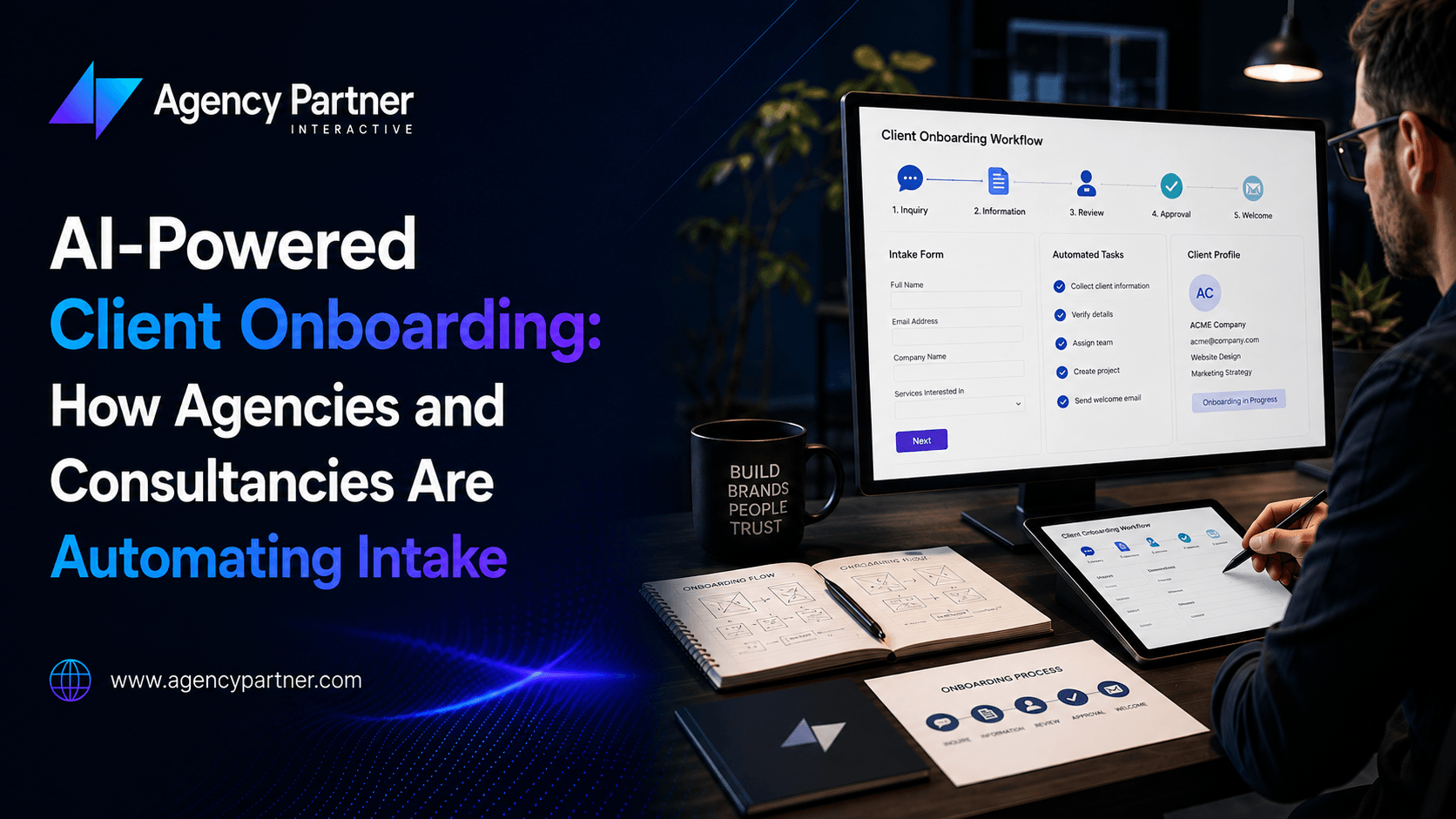
This is what competitors consistently miss: not the tools, but the actual automated onboarding process flow. Here’s a real agency intake-to-kickoff workflow that runs in 2026 with minimal human involvement:
Step 1: Intake Form (Automated)
Client receives a branded intake form the moment the contract is signed, triggered automatically from the e-signature platform. The form captures: goals, key contacts, brand assets, existing tools, access credentials, and decision-maker preferences. No email chase. No “did you get my message?”
Step 2: CRM and Project Setup (Automated)
The completed intake response triggers Zapier or Make to automatically: Create the CRM contact and deal record, build the project in your PM tool, assign team members, set milestone dates, and send the client a welcome email with their project link and timeline.
Step 3: Document Generation (AI-Powered)
An AI agent, Claude or GPT-4o connected to your intake data, auto-generates the kickoff document, account brief, and initial scope summary using the client’s own answers. Taskip’s own data shows this reduces client onboarding time by 40%. What used to take 90 minutes of template-filling takes 4 minutes.
Step 4: Access and Asset Collection (Automated)
Conditional logic in your onboarding tools for customer data automation requests only the assets relevant to the engagement type. Digital marketing clients get a brand asset checklist. Web development clients get a hosting credentials request. The system follows up automatically if assets aren’t received within 48 hours. This is where automated data onboarding pays its clearest dividend, no more “can you resend that brief?” emails. Onboarding tools for customer data automation that include conditional logic reduce asset collection time by an average of 60% compared to static checklist emails.
Step 5: Kickoff Scheduling (Automated)
Calendly or Cal.com sends the scheduling link with a pre-populated agenda based on the intake responses. The automated customer onboarding process ends with a calendar invite, pre-read document, and reminder sequence, without a human sending a single email.
The entire sequence, from contract signature to kickoff-ready, takes under 24 hours with automated client onboarding. Without it, the same sequence takes 3–7 business days of back-and-forth. Onboarding automation tools that integrate these five steps are what agencies running 30+ new client engagements per year consider mission-critical infrastructure — not a productivity experiment.
Why Automated Onboarding Directly Impacts Retention and Revenue
Agencies frame automated client onboarding as an efficiency win. It’s actually a retention strategy. Companies with optimized onboarding automation see 53% higher day-30 retention rates, with 82% of customers who complete full onboarding reporting high satisfaction compared to just 19% for partial completion.
The psychology is straightforward: a client who experiences a smooth, professional, fast automated onboarding process immediately builds trust in your team’s competence. They’re signaled that you run a tight operation. That confidence carries into the relationship, and into renewal conversations.
Companies using AI for onboarding see a 30% increase in customer retention within the first six months. For an agency billing $5,000/month per client, 30% better retention across even 10 clients represents $150,000+ in preserved annual revenue from a system that costs a fraction of that to implement.
User onboarding automation also enables something manual processes can’t: personalization at scale. An automated onboarding software solution with conditional logic delivers a different intake sequence to an e-commerce client vs. a SaaS client vs. a professional services firm, automatically, without any team member making that judgment call. User onboarding automation at this level of sophistication was enterprise-only two years ago. In 2026, it’s accessible through tools like Moxo, Taskip, and Make at SMB price points.
Automated data onboarding, the process of automatically ingesting and organizing client-provided data into your systems, eliminates one of the most error-prone steps in manual intake. When a client submits their brand guidelines, Google Analytics access, and existing keyword rankings through a structured automated data onboarding form, that data flows directly into your PM tool and analytics stack, no manual copying, no transcription errors, no “we lost that in the email thread.”
Customer onboarding automation that includes data ingestion as a core feature is what separates best-in-class automated client onboarding from basic intake form digitization. Automating client onboarding fully means automating the data, not just communication.
The Best Onboarding Automation Tools for Agencies in 2026
Choosing the right automated onboarding software depends on what problem you’re primarily solving. Here are the onboarding automation tools agencies and consultancies are actually using in 2026:
For End-to-End Client Onboarding Workflows: Moxo
The strongest purpose-built customer onboarding automation platform for professional services. Handles multi-stakeholder workflows, document collection with audit trails, and approval routing. Built specifically for agencies, financial services, legal, and consulting firms that need enterprise-grade automated client onboarding with accountability built in. The best choice for any agency whose automate client onboarding requirements include regulated data or multi-party approvals.
Taskip: Best for Agencies Automating Intake-to-Project-Setup Sequences
Integrates with Claude and Midjourney for AI-generated briefs as part of the automate onboarding process flow. Reduces onboarding time by 40% per client in documented case data. One of the most agency-specific onboarding automation tools available in 2026.
For Workflow Orchestration: Zapier / Make
The backbone of most automated onboarding process stacks. Connects e-signature → CRM → PM tool → email in fully automated sequences. Essential for any automate onboarding process initiative spanning multiple tools. Flexible enough to serve as the orchestration layer for any automated onboarding software ecosystem.
For Document Collection and Signature: PandaDoc / DocuSign
The trigger layer. When a contract is signed, everything else begins. Also handles automated data onboarding of signed agreements into your document management system.
For Intelligent Intake Forms: Typeform + Zapier or Fillout
Conditional logic forms feeding clean data into your CRM and PM tool. The front end of any onboarding tools for customer data automation stack. Onboarding tools for customer data automation that include smart routing and conditional branching reduce data cleanup time by up to 80% compared to static email attachments.
For AI-Assisted Document Generation: Claude API / ChatGPT API
Connected to intake data, these generate kickoff documents, client briefs, and SOPs automatically. The highest-leverage AI layer in an automated client onboarding system for agencies. Customer onboarding automation that includes AI document generation is where most agencies find their fastest measurable ROI. Automated data onboarding of client-provided information, from brand guidelines to analytics credentials, flows directly into your systems without manual handling. Automate onboarding process investments in this layer recover the most hours per client of any single tool category. Automated data onboarding that connects intake forms to your analytics stack eliminates an entire category of onboarding delay.
How to Automate Client Onboarding Without Losing the Human Element?
The most common objection to user onboarding automation: “Our clients need the personal touch.” Valid concern. Wrong conclusion.
Human-led moments should include welcome meetings, feedback discussions, mentorship, and cultural integration. These interactions build trust, convey values, and ensure employees feel valued, areas where technology should support, not replace, people.
The same principle applies to client onboarding. Automated customer onboarding process systems handle the mechanical and sequential. Humans handle the relational and strategic. The goal isn’t to remove humans from onboarding, it’s to remove humans from the parts of onboarding that don’t require them.
A well-designed automated onboarding process actually creates more space for meaningful human contact, because your team isn’t spending their first 5 hours on a new engagement chasing intake forms. They’re spending that time on the kickoff call, the strategy session, the relationship.
The agencies that resist automate client onboarding investments on “personal touch” grounds are usually the ones whose teams are most burned out by administrative overhead. Automation doesn’t reduce relationship quality. It protects the capacity to deliver it.
Building Your Automated Onboarding Stack: Where to Start
Automate onboarding process in phases, not all at once. The highest-ROI sequence for any agency ready to automate client onboarding:
Phase 1 (Week 1–2)
Intake and CRM Build a conditional logic intake form. Connect it to your CRM via Zapier or Make. Auto-create the client record and project on form completion. This single change eliminates 60–80% of administrative back-and-forth. Automated onboarding process phase one is the fastest path from manual chaos to structured efficiency, and most agencies complete it in under two weeks.
Phase 2 (Week 3–4)
Document Generation and Collection Connect intake outputs to an AI document generator. Add automated asset request sequences with follow-up logic. Your automated onboarding software stack now handles the two most time-consuming manual steps. Automated data onboarding of client assets, brand files, credentials, campaign data, flows directly into your systems without a team member touching it.
Phase 3 (Week 5–6)
Communication and Scheduling Add automated welcome emails, kickoff scheduling links, and pre-kickoff prep sequences. Your automated client onboarding system now runs end-to-end. Onboarding automation tools at this layer eliminate the 8–15 follow-up emails most agencies send per new client.
Phase 4 (Ongoing)
Measurement and Optimization Track: time-to-kickoff, completion rates, client satisfaction scores, and team hours saved. Customer onboarding automation ROI compounds, the more clients you onboard through the system, the more refined and efficient it becomes. Automated customer onboarding process measurement should include day-30 retention alongside efficiency metrics, because that’s where the revenue impact shows up.
Gartner estimates that by the end of 2026, 40% of enterprise applications will use task-specific AI agents to orchestrate work across systems. The agencies building their customer onboarding automation infrastructure now will have a significant operational advantage over those starting from scratch in 2027.
User onboarding automation and automated onboarding process capabilities compound, each new client makes the system smarter, faster, and more personalized. Onboarding tools for customer data automation improve with usage data. Automate onboarding process investments made in Q2 2026 generate returns through 2028 and beyond. The agencies winning this decade aren’t the ones with the most talented teams, they’re the ones whose onboarding automation tools free their talented teams to do what only humans can do.
Automated customer onboarding process systems are how that freedom gets built. Automated onboarding software is the investment. User onboarding automation is the outcome. And automate client onboarding at scale is the competitive advantage that compounds annually.
The Before and After: What Changes When You Automate Client Onboarding
| Manual Onboarding | Automated Onboarding | |
|---|---|---|
| Time to kickoff-ready | 3–7 business days | Under 24 hours |
| Hours per client | 5+ hours | 1–2 hours (review only) |
| Follow-up emails sent | 8–15 per client | 0 (system handles) |
| Data entry errors | Common | Near-zero |
| Client satisfaction | Variable | Consistently high |
| Team morale | Onboarding fatigue | Focused on delivery |
| Day-30 retention | Baseline | 53% higher |
The automated onboarding process column isn’t a future state. It’s what agencies using the tools in this guide are operating today.
FAQs
What is automated client onboarding?
Using automated onboarding software and AI to handle intake, document collection, CRM setup, and kickoff prep, without manual team effort.
How much time do onboarding automation tools save?
Onboarding automation tools reduce onboarding time by 40–70%, roughly 2–4 hours recovered per new client engagement.
What tools do you need to automate the onboarding process?
Core onboarding tools for customer data automation: Typeform or Fillout (intake), Zapier or Make (automate onboarding process), CRM, PM tool, e-signature, and AI document generator. Automated onboarding software like Moxo bundles these into one platform.
Does automated customer onboarding process hurt the client relationship?
No. Automated customer onboarding process systems handle mechanical steps; your team uses saved time for strategic work. User onboarding automation improves the client experience, faster, more consistent, more professional.
What is the ROI of customer onboarding automation?
Onboarding tools for customer data automation deliver 5:1 average ROI, automated data onboarding eliminates costly data entry errors, and user onboarding automation drives 53% higher day-30 retention.
Is your agency still spending 5 hours per client on manual intake? The decision to automate onboarding process end-to-end is the most impactful operational investment most agencies haven’t made yet. User onboarding automation that actually works, automate client onboarding flows that run overnight — that’s what we build. Talk to our team.