Design Insights
E-Learning Platform Design Guide for Modern Education
Many e-learning platforms struggle not because they lack features, but because they attempt to do too much too soon. Platforms are often designed around administrative requirements, content storage, or technical constraints, rather than around the learner’s actual journey. When this happens, learners are forced to navigate complex dashboards, unclear pathways, and overloaded interfaces that quietly erode motivation.
Effective e-learning platform development takes a different approach. It prioritizes clarity over complexity and flow over feature density. Strong learning website design ensures that learners always understand where they are, what they should do next, and how their progress is measured. When these signals are missing, dropout rates rise, often without institutions ever receiving direct feedback.
This leads to an important reflection for any organization planning to build e learning website experiences: Are learners adapting to your system, or is your system adapting to learners?
Design Learning Experiences That Support How People Actually Learn
At its core, design learning is about aligning digital experiences with human cognition. Learners absorb information more effectively when content is structured, predictable, and presented in manageable segments. Overly dense layouts or unclear navigation increase cognitive load, making learning feel like work rather than progress.
Modern platforms rely on learning design software combined with a structured learning design system to create consistency across lessons, modules, and courses. These systems ensure that learners encounter familiar patterns as they move through content, reducing friction and building confidence. Over time, this consistency plays a major role in improving completion rates and satisfaction.
Quiet question worth asking: Is learning effortless on your platform?
How to Create an E Learning Platform With Strong UX Foundations?
Organizations exploring how to create an e learning platform often focus heavily on content creation and technical infrastructure. However, without strong UX foundations, even the best content struggles to perform. This is where lms ux design becomes critical.
Effective LMS UX design simplifies decision-making for learners. Clear dashboards, visible progress indicators, and logical navigation paths reduce uncertainty and encourage momentum. Learners should never feel lost inside a platform or unsure about their next step. Instead, each interaction should reinforce a sense of progress and purpose.
When institutions build an online learning platform with UX as a core pillar, they create environments that learners want to return to, not because they have to, but because the experience feels supportive and rewarding.
Elearning Templates vs Custom E Learning Design
Speed is often the reason teams turn to elearning templates or e learning website templates. Templates can be useful for rapid deployment, internal training programs, or pilot projects. However, they also introduce limitations in flexibility, branding, and long-term scalability.
A custom e learning design approach allows organizations to align educational goals, user behavior, and brand identity within a single cohesive experience. With custom design elearning, platforms are no longer constrained by generic layouts or pre-defined interactions. Instead, they can evolve alongside learner needs and institutional growth.
A custom e learning design approach allows platforms to align:
- Pedagogical goals
- Brand identity
- Learner behavior
The decision ultimately comes down to intent. Templates help you launch quickly. Custom design helps you differentiate and scale sustainably.
Honest checkpoint: Do you want speed or differentiation?
E Learning Website Design That Prioritizes Accessibility and Inclusion
Accessibility is no longer an optional consideration in e learning website design. Learners come from diverse backgrounds and may rely on assistive technologies, alternative input methods, or different learning environments. Inclusive learning website design ensures that all users can participate fully and comfortably.
Designing for accessibility includes thoughtful typography, strong contrast, keyboard navigation, screen-reader compatibility, and clear content hierarchy. Importantly, these improvements enhance usability for everyone, not just users with specific needs. Inclusive e-learning platform development builds trust, improves engagement, and future-proofs platforms against compliance and usability challenges.
An important question institution should ask is whether their platform truly supports every learner it aims to serve.
Create Online Learning Platform Experiences That Hold Attention
Attention is one of the most valuable, and fragile, resources in digital education. To create online learning platform experiences that sustain engagement, interaction must be intentional rather than decorative. Static content and passive videos no longer meet learner expectations.
This is where interactive elearning design plays a transformative role. Interactive assessments, scenario-based exercises, discussion prompts, and adaptive feedback loops turn learners into active participants. These elements encourage reflection, application, and curiosity, which significantly improve knowledge retention.
Thoughtful learning website design includes:
- Clear typography and spacing
- Strong contrast and visual clarity
- Keyboard and screen-reader compatibility
Inclusive e-learning platform development doesn’t just meet standards. It builds trust.
Ask yourself: Can everyone learn here equally?
Responsive Elearning Design for Learning Across Devices
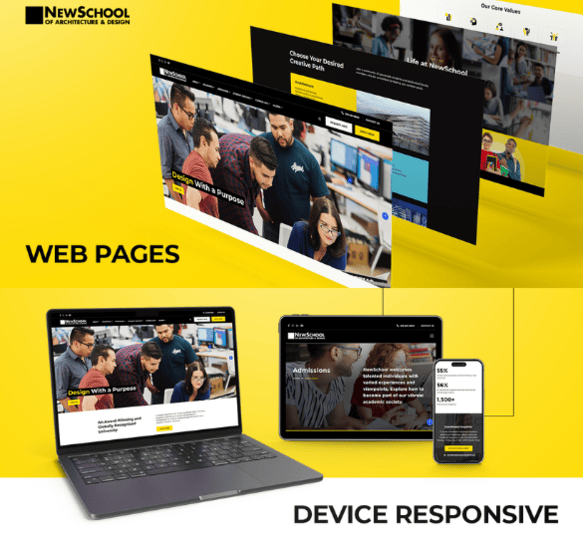
Learning no longer happens in a single place or on a single device. Learners switch between desktops, tablets, and mobile phones throughout the day. Without responsive elearning design, this continuity breaks down, leading to frustration and disengagement.
A responsive approach ensures that layouts, interactions, and content adapt seamlessly to different screen sizes. When teams build e learning website platforms with responsiveness in mind, they create consistent experiences that support learning anytime and anywhere.
Strong responsive elearning design is not just a technical requirement, it is a fundamental expectation of modern learners.
Learning Design Software and the Importance of Design Systems
While learning design software accelerates prototyping and iteration, long-term success depends on consistency. This is where a structured learning design system becomes essential. Design systems define reusable components, interaction patterns, and visual standards that scale across courses and updates.
Without a design system, platforms often become fragmented as new features and content are added. With one, teams can maintain coherence while expanding offerings. This approach supports sustainable e-learning platform development and reduces maintenance complexity over time.
Scalability, in this context, is not just about infrastructure, it is about experience consistency.
LMS UX Design That Improves Completion and Retention
Completion rates are a direct reflection of user experience. When learners abandon courses, the cause is often not difficulty, but friction. Effective lms ux design minimizes that friction by making progress visible, actions predictable, and feedback timely.
Clear milestones, supportive notifications, and intuitive assessment flows help learners stay motivated. When the LMS feels like a guide rather than a gatekeeper, learners are more likely to persist through challenges and complete their learning journeys.
This reinforces the idea that UX is not a cosmetic layer, but a core driver of educational outcomes.
Build an Online Learning Platform That Evolves Over Time
Organizations that build an online learning platform often focus heavily on launch. However, long-term success depends on adaptability. As content grows, audiences expand, and learning models evolve, design must remain flexible.
Scalable platforms rely on modular structures, role-based experiences, and adaptable navigation patterns. This ensures that growth does not compromise usability. When scalability is built into e-learning platform development, platforms remain effective well beyond their initial release.
The key consideration is whether today’s design decisions will still support tomorrow’s learners.
Long-term lens: Will this platform still work in three years?
Conclusion
Modern education is no longer defined solely by content quality or technological capability. It is defined by experience. Thoughtful e-learning platform development, grounded in strong design learning, lms ux design, and interactive elearning design, determines whether learners remain engaged and achieve meaningful outcomes.
By investing in custom e learning design, prioritizing responsive elearning design, and supporting growth through a cohesive learning design system, organizations can create an e learning platform that is intuitive, inclusive, and future-ready. In a digital-first education landscape, platforms that feel human, clear, and engaging are the ones that truly succeed.
FAQs
Q1: What makes an e-learning platform effective for modern learners?
Ans: An effective platform combines intuitive lms ux design, engaging interactive elearning design, and clear learning pathways. When learners understand how to navigate content, track progress, and apply knowledge, engagement and completion rates improve significantly.
Q2: Is custom e learning design worth the investment?
Ans: Yes. While elearning templates offer speed, custom e learning design provides flexibility, scalability, and stronger learner engagement. Institutions focused on long-term growth and differentiation benefit most from custom design elearning approaches.
Q3: How long does it take to build an online learning platform?
Ans: To build an online learning platform with strong UX, accessibility, and responsiveness typically takes several months. Timelines vary based on scope, but thoughtful planning during e-learning platform development reduces rework and improves long-term performance.
Q4: Why is responsive elearning design so important?
Ans: Responsive elearning design ensures learners can access content seamlessly across devices. As learning increasingly happens on mobile and tablets, responsiveness directly impacts accessibility, engagement, and learner satisfaction.
Q5: What role does LMS UX design play in retention?
Ans: Strong lms ux design reduces friction, clarifies progress, and supports learner motivation. Platforms with intuitive UX consistently achieve higher completion rates and better learning outcomes.
Q6: Can e-learning platforms support different learning styles?
Ans: Yes. Modern learning design software and interactive elearning design support visual, auditory, and experiential learning styles, allowing platforms to accommodate diverse learner preferences effectively.
Q7: Is accessibility necessary in e learning website design?
Ans: Absolutely. Inclusive e learning website design ensures equal access for all learners, improves usability overall, and helps institutions meet compliance and ethical standards in digital education.