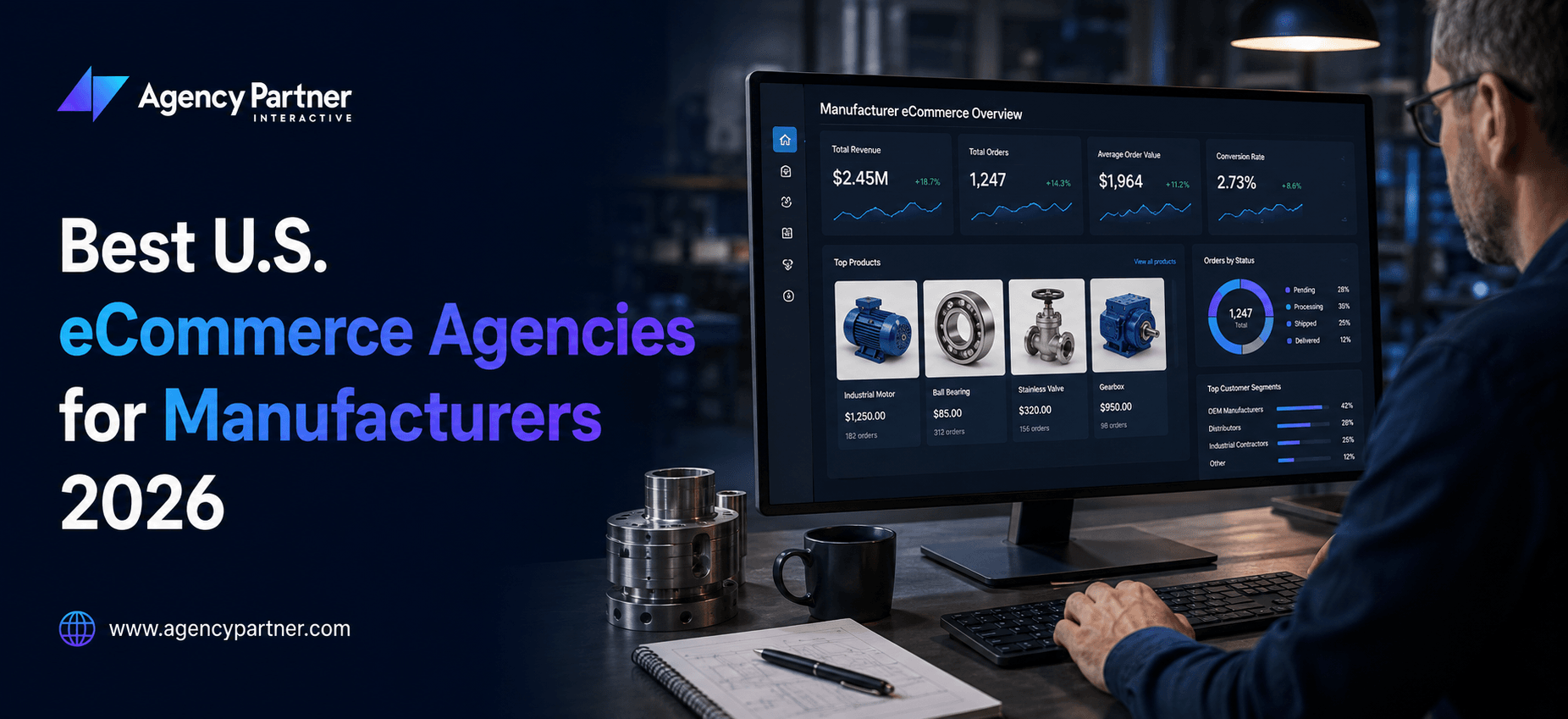
Choosing an ecommerce agency for a manufacturing business involves more than reviewing storefront designs. Your project may depend on account-specific pricing, dealer access, product specifications, quote approvals, and reliable connections with existing business systems.
When evaluating ecommerce development services, start with how your customers buy and how your team processes their orders. Those requirements provide a more useful basis for comparison than a general list of platform features.
This guide presents ten agencies from our existing shortlist and a framework for assessing their fit. Inclusion is not an independent certification or a guarantee of suitability. Confirm current capabilities, delivery arrangements, and relevant project experience directly with each provider.
Disclosure: Agency Partner Interactive publishes this article and is included in the shortlist. Evaluate our proposal using the same requirements and evidence you request from other agencies.
What Makes Manufacturing Ecommerce Different?
Manufacturers may sell through distributors, dealers, direct business accounts, or a combination of channels. The website must reflect those relationships without creating conflicts between customer access, pricing, and operational data.
For example, a replacement parts supplier may need customers to identify compatible products, view negotiated prices, and reorder from purchase history. Another manufacturer may need a quote request instead of immediate checkout because specifications and capacity require review.
Document your actual buying process before selecting an agency or platform. Not every manufacturer needs every B2B feature.
What to Look for in a Manufacturing Ecommerce Partner
1. ERP and Business System Integration
List the systems controlling inventory, customer accounts, prices, orders, and invoices. Ask each agency which integrations it has delivered and request examples relevant to your environment.
Clarify how updates are exchanged, which system controls each data type, and how failed transactions are detected and recovered.
Where existing connectors cannot support essential business rules, custom software development services may be relevant. Confirm the gap before commissioning additional software.
2. Dealer and Customer Account Workflows
Explain how dealers, distributors, purchasing teams, and administrators should access the store. Define permissions for catalogs, pricing, order placement, and account management.
For specialized portals, assess whether the commerce platform can support the workflow or whether separate web application development services are required.
Ask providers to demonstrate permission boundaries, not simply a successful login.
3. Product Information and Catalog Management
Manufacturing catalogs may include technical documents, compatibility information, multiple units, configurable options, and replacement parts relationships.
Ask how product data will be imported, validated, updated, and presented. Identify who will maintain it after launch.
CMS development services can support editorial and publishing requirements, while product data may need a separate product information or operational system. Confirm these responsibilities rather than treating all content as the same type of data.
4. Pricing, Quotes, and Purchasing Approvals
Document negotiated prices, minimum quantities, payment terms, quote approvals, and other rules that apply to your customers.
Ask the agency to explain where these rules will operate and how they will be tested. A quoted price should not conflict with the price used during order processing.
Distinguish an estimated price, an approved quote, and a confirmed order. The customer interface should make those differences clear.
5. A Usable Buying Experience
Technical capability is useful only when customers can complete their tasks. Review product discovery, specification comparison, repeat ordering, quote requests, and administrative work.
UI/UX design services can help evaluate these journeys before implementation. Request evidence of testing with representative users rather than relying only on visual mockups.
6. Search Visibility for Public Catalog Content
Identify which products and categories should be publicly discoverable and which account-specific information must remain private.
Ask how the project will handle product URLs, filters, discontinued items, redirects, and public page content. Ecommerce SEO services may be relevant where catalog architecture and search discovery require specialist input.
7. Support After Launch
Confirm who monitors integrations, resolves incidents, applies updates, and evaluates changes to connected systems.
Review support coverage, escalation arrangements, documentation, and access to essential accounts. Use our website launch checklist as a starting point for release verification, then add manufacturing-specific acceptance tests.
10 Agencies to Include in Your Evaluation
The agencies below remain from the original shortlist. Treat each entry as a starting point for due diligence rather than a verified ranking. Ask for current evidence against your written requirements.
1. Agency Partner Interactive
Consider Agency Partner Interactive when you want to discuss storefront implementation alongside design, business workflows, and integration requirements.
Review our case studies for project context and our client reviews for customer feedback. Ask which examples are directly relevant to your manufacturing requirements and what work our team would perform within your proposed scope.
Platform-specific service options include Magento development services, Shopify development services, and WooCommerce development services.
Platform availability alone does not establish suitability. Request a recommendation based on your catalog, customer accounts, pricing rules, and operational systems.
2. Corevist
Include Corevist in your supplier review when assessing options for a manufacturing commerce project. If SAP integration is central to your requirements, ask for a demonstration covering the specific data and transactions your business needs.
Confirm implementation responsibilities, customer access controls, operating costs, and support arrangements.
3. DCKAP
When reviewing DCKAP, prioritize evidence of integration delivery. Request an explanation of how inventory, pricing, customer records, and orders would move between your systems.
Ask how synchronization failures are monitored and how staff can reconcile affected records.
4. Web Solutions NYC
Ask Web Solutions NYC to explain the proposed platform and integration architecture against your manufacturing requirements.
Request relevant project references and clarify which parts of the delivery are handled directly, through platform capabilities, or by third parties.
5. Elogic Commerce
Evaluate Elogic Commerce against your catalog complexity, storefront requirements, and dealer or distributor workflows.
Confirm the proposed delivery team’s platform experience and request evidence for any certifications or project statistics used in the proposal.
6. Silk Commerce
If your project includes several dealer or distributor storefronts, ask Silk Commerce to demonstrate how shared content, local differences, account permissions, and reporting would be managed.
Confirm licensing, implementation responsibilities, and the operational work required to maintain multiple storefronts.
7. Human Element
Ask Human Element for manufacturing project examples that resemble your customer journey and operational environment.
Review how the team approaches product data, purchasing workflows, and collaboration with internal business system owners.
8. Corra
When evaluating Corra, ask how the proposed customer experience will support your B2B requirements alongside the operational functionality.
Request examples of product discovery, account pricing, repeat ordering, or quote workflows relevant to your business.
9. Valtech
For a project involving several regions, systems, or business units, ask Valtech to explain delivery governance, local requirements, and ownership across teams.
Confirm whether the proposed engagement size and ongoing operating model suit your organization.
10. ECommerce Partners
Ask ECommerce Partners to demonstrate the proposed platform’s fit for your customer accounts, pricing structure, and integrations.
Review migration assumptions, extension dependencies, implementation responsibilities, and support after release.
Compare Platforms Before Comparing Agency Prices
Different platform recommendations can produce very different proposals. Clarify whether each agency is estimating the same features, data migration, integrations, and support responsibilities.
If Shopify and WooCommerce are on your shortlist, use our Shopify versus WooCommerce comparison as background for the discussion. Confirm current capabilities and plan requirements against your own scope.
Also distinguish interface choices from operational architecture. Our guide to custom ecommerce website design versus templates explains when theme configuration, targeted customization, or a custom storefront may be appropriate.
Do not assume that a custom interface requires replacing every commerce capability. Equally, do not assume that an attractive theme can support complex account and ordering rules without additional work.
Questions to Send Every Shortlisted Agency
- Which manufacturing requirements can the proposed platform support directly?
- Which requirements need extensions, integrations, or custom development?
- What similar projects can you demonstrate?
- Which system will control pricing, inventory, and customer data?
- How will failed orders or synchronization problems be detected?
- What assumptions, exclusions, and recurring fees are included?
- Who owns the accounts, implementation code, and documentation?
- What support is available after launch?
Use the same written brief for each agency. Compare evidence and scope before comparing the headline price.
Frequently Asked Questions
Does a manufacturer need a fully custom ecommerce platform?
Not necessarily. An established platform may support the requirements through configuration, extensions, or targeted integrations. Custom work should address a demonstrated gap.
What should I prioritize when choosing an agency?
Prioritize relevant delivery experience, platform fit, integration capability, clear scope, and a support arrangement your business can operate.
Should ERP integration be included in the initial estimate?
Yes, when it is necessary for the project. Document the systems, data flows, access requirements, and expected failure handling before comparing proposals.
Can a manufacturer use Shopify or WooCommerce?
Potentially. Assess the specific platform configuration against pricing, account, catalog, and integration requirements rather than selecting by business category alone.
How can I verify an agency’s claims?
Request relevant project references, demonstrations, current credential evidence, and a clear explanation of the proposed delivery team’s responsibilities.
Choose an Agency Around Your Operational Requirements
A useful shortlist connects your buying process and internal systems with evidence of appropriate delivery capability. Write down the requirements, request comparable proposals, and confirm who will operate and support the solution.
Discuss your manufacturing ecommerce project with Agency Partner Interactive to review your catalog, customer workflows, integrations, and implementation options.