Your business started with five employees and three software subscriptions. Today, you have 75 employees, six departments, and 12 applications that barely communicate. Your sales team enters the same information twice. Operations relies on spreadsheets. Finance spends hours reconciling data between platforms.
Sound familiar? This is often when growing companies begin comparing Custom Software vs SaaS. Software that worked during the startup stage may struggle to support more customers, employees, and complex processes.
The challenge is deciding whether to invest in a custom application or continue using subscription-based software. Both approaches offer advantages, but the right choice depends on your business needs, budget, and growth plans.
This guide compares Custom Software vs SaaS Development, including costs, scalability, security, ownership, and implementation timelines. You’ll also learn when each approach makes financial sense and how to choose without making an expensive mistake.
What Is the Difference Between Custom Software and SaaS?
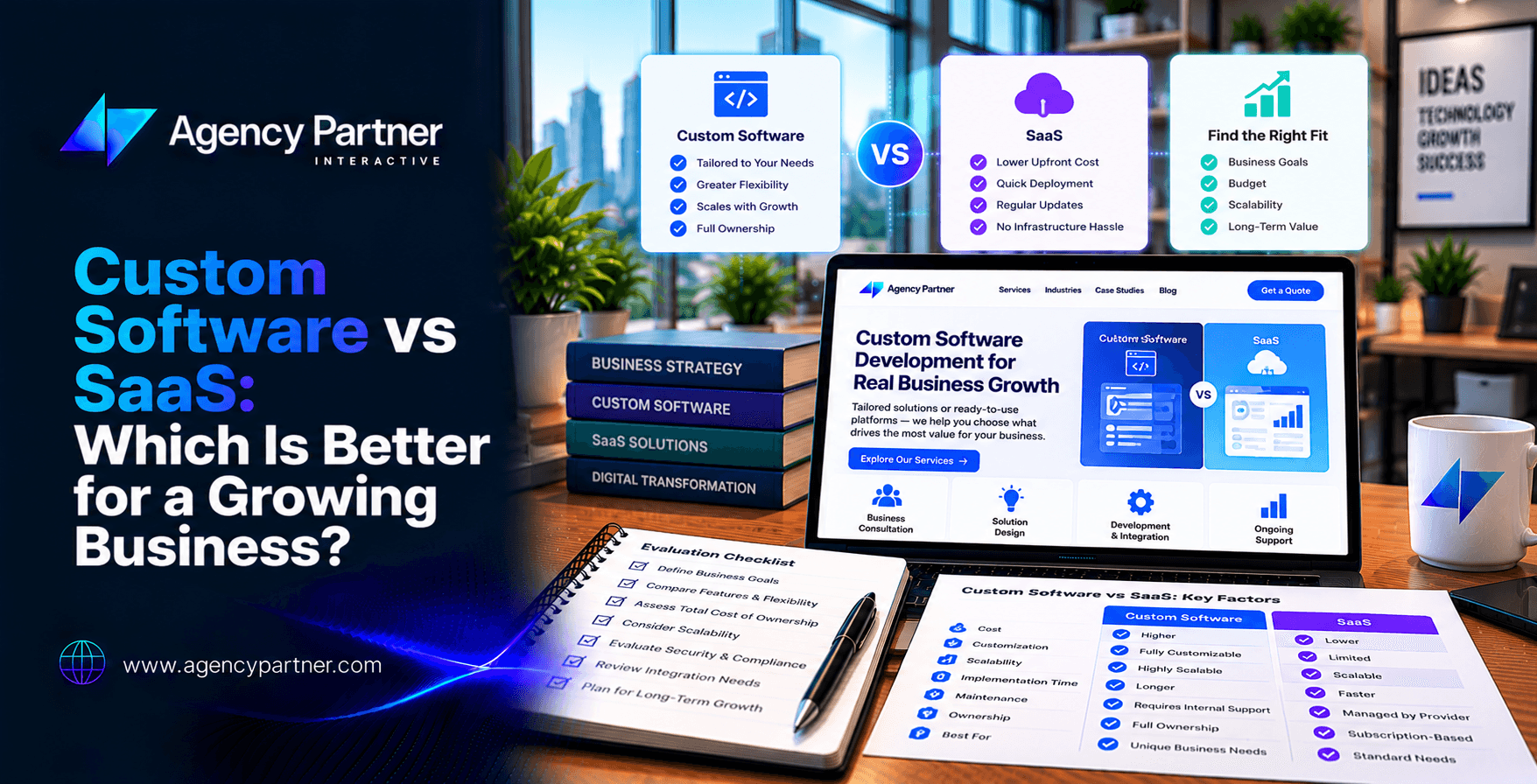
The main difference between custom software and SaaS is ownership and control. Custom software is developed around a company’s specific requirements. SaaS, or Software as a Service, provides access to applications managed by an external provider.
Both can operate in the cloud, support multiple users, and integrate with other business systems. However, they differ in how they are developed, maintained, and customized.
What Is Custom Software Development?
If you’re wondering what is custom software development, it is the process of designing and building applications for a specific organization’s needs. Unlike ready-made software, custom applications are created around defined workflows, users, and business goals.
Examples include:
- Custom customer portals
- Inventory management systems
- Internal workflow applications
- Industry-specific CRM platforms
- Automated reporting dashboards
- Enterprise resource planning integrations
Businesses often invest in custom software development services when existing applications cannot support their operations without expensive workarounds. The main advantage is flexibility. Instead of changing your processes to fit a platform, you can build software around the way your company operates.
What Is SaaS Application Development?
Understanding what is saas application development requires distinguishing between using SaaS and building it. When businesses subscribe to SaaS, they access software maintained by a provider.
When companies invest in saas product development, they create subscription-based applications that other businesses or customers can use. For example, a company may subscribe to an existing CRM or build its own cloud-based project management platform to sell commercially.
According to the National Institute of Standards and Technology, SaaS allows customers to use provider-managed applications without controlling the underlying cloud infrastructure. This model reduces infrastructure responsibilities for subscribers but limits control over the core product.
Custom Software vs SaaS: A Side-by-Side Comparison
Before choosing an approach, businesses should understand the main differences.
| Factor | Custom Software | SaaS |
| Initial investment | Usually higher | Usually lower |
| Implementation time | Weeks to months | Days to weeks |
| Customization | Extensive | Limited by provider |
| Ownership | Defined by development contract | Provider owns the platform |
| Maintenance | Business or development partner | Primarily SaaS provider |
| Scalability | Depends on architecture | Depends on subscription and platform |
| Integrations | Can be purpose-built | Depends on available APIs |
| Security | Requires dedicated management | Shared between provider and customer |
| Ongoing costs | Hosting, support, improvements | Subscription and usage fees |
| Feature updates | Controlled by the business | Controlled by the provider |
The Custom Software vs SaaS comparison shows that neither option is automatically better. SaaS reduces the effort required to start using software. Custom development offers greater flexibility when standard applications cannot meet business needs. The most important question is whether the software supports your operations today and can continue supporting them as your business grows.
- Which Option Costs Less: Custom Software or SaaS?
Cost is usually the first concern when businesses compare software options. SaaS generally requires less money upfront because the provider has already developed the application.
Companies pay monthly or annual fees based on users, features, or usage. Custom software requires an initial investment in planning, design, development, and testing. However, subscription costs can grow as businesses expand.
How Much Does SaaS Cost Over Time?
Consider a hypothetical business using a SaaS platform that costs $80 per employee each month. With 50 employees, the annual subscription costs $48,000. If the company grows to 150 employees, that same subscription costs $144,000 annually, assuming pricing remains unchanged. These figures exclude premium features, integrations, and implementation costs.
How Much Does Custom Software Cost?
Custom applications have different cost structures. Businesses typically pay for development, hosting, maintenance, security, and future improvements. A focused internal application may require a much smaller investment than a complex enterprise platform.
The right budget depends on the features and systems involved. This is one reason why custom software development is important for some growing businesses. A tailored application may reduce recurring licensing expenses or costly manual work. However, custom development is not automatically cheaper over time.
Compare Total Cost of Ownership
A fair Custom Software vs SaaS Development comparison should examine costs over three to five years.
Include:
- Initial setup or development
- Subscription or hosting fees
- Integrations and migration
- Training and support
- Maintenance and upgrades
- Internal administration
- Future switching costs
Business takeaway: Choose the option with the strongest long-term value, not simply the lowest starting price.
- Which Is Better for Business Scalability?
Growing businesses need software that can support increasing demand. This may involve more employees, customers, transactions, or locations. SaaS platforms often make expansion straightforward.
Businesses can upgrade subscription plans, add users, and activate additional features. However, growth can become expensive when pricing depends heavily on users or transaction volume.
How Do Custom Software Solutions Support Growth?
Well-designed custom software solutions can support expansion through flexible architecture, new integrations, and features tailored to changing requirements. For example, a logistics company may need to introduce automated dispatching across several warehouses.
An existing SaaS platform might support basic scheduling but lack the company’s specialized routing rules. Custom development could address those requirements without forcing employees to manage additional spreadsheets.
The right architecture matters. Poorly developed custom applications can also become difficult to scale. Businesses should evaluate expected transaction volumes, infrastructure needs, and future functionality before development begins. A qualified provider of software development services can help identify these requirements during discovery.
- How Much Customization Does Your Business Need?
Customization is one of the biggest differences between SaaS and custom applications. SaaS platforms typically offer configurable dashboards, user permissions, templates, and integrations. For many businesses, these options are sufficient. However, configuration is not the same as complete control.
When Does Customization Become Necessary?
Consider a manufacturing company with a unique production approval process. Its employees must review materials, verify quality standards, and obtain approvals before production begins. If existing software cannot support these steps, employees may rely on manual workarounds.
This is where custom software development services can provide value. Developers can build approval workflows, reporting tools, and integrations around the company’s requirements.
Custom applications may also support industry-specific compliance processes. The key is distinguishing between essential requirements and preferences. Building expensive functionality simply because employees prefer a familiar interface rarely creates a strong business case.
Ask yourself: Is your current software limiting growth, or does your team simply need better training and configuration?
- Which Is More Secure: Custom Software or SaaS?
Security should influence every software decision. However, neither SaaS nor custom software is automatically more secure. Both can provide strong protection when properly designed, configured, and maintained.
SaaS Security Responsibilities
SaaS providers generally manage the underlying application infrastructure, platform updates, and many technical security controls. Customers remain responsible for areas such as user access, account configuration, and appropriate data handling.
Before selecting a provider, review its security documentation, incident response procedures, data processing terms, and available certifications.
Custom Software Security Responsibilities
With custom applications, businesses have greater control over security architecture. They can define access permissions, authentication methods, data retention rules, and integration requirements.
However, this also creates additional responsibility. Secure development, vulnerability testing, monitoring, and regular updates must be included in the project.
Professional software development services should address security throughout development rather than adding it immediately before launch.
What About Data Ownership?
Custom development contracts should clearly define intellectual property ownership, source code access, and data rights. For SaaS, review the provider’s terms governing data ownership, exports, retention, and account termination. The safest choice is the one that meets your security requirements and has clear operational accountability.
- How Do Integrations Affect the Decision?
Most growing businesses already use several software platforms. Replacing every application is rarely practical. Instead, companies need systems that exchange information reliably.
For example, a business may use separate tools for CRM, accounting, inventory, and customer support. If employees repeatedly transfer information between them, the company loses time and increases the risk of errors.
SaaS Integrations
Many SaaS platforms provide ready-made connectors and APIs. These can simplify integration with widely used business applications. However, some integrations require premium subscriptions or third-party middleware.
Custom Integrations
Custom software solutions can connect systems using purpose-built APIs and data workflows. For example, a custom order management application could synchronize customer information, inventory levels, and invoices across existing platforms.
This approach can reduce manual work without replacing every system. For businesses considering Custom Software vs SaaS Development, integration complexity may be more important than the features listed on a product’s website. A focused integration project may solve the problem without requiring a completely new application.
- Which Software Option Can Be Implemented Faster?
Speed matters when a business needs to solve an immediate problem. SaaS generally offers faster implementation because the application already exists. A company can subscribe, configure user accounts, migrate data, and begin training employees. However, complex enterprise implementations can still take months.
Custom Software Development Timelines
Custom applications require discovery, planning, design, development, testing, and deployment. A focused MVP may take several months, while a complex enterprise system can take significantly longer.
The timeline depends on integrations, security requirements, and project scope. For businesses seeking rapid deployment, SaaS is often the practical choice. However, saas application development services are relevant when a company wants to build its own subscription software rather than purchase an existing product.
A saas development company can help plan the application architecture, user management, billing workflows, and infrastructure required to operate a commercial SaaS product. The important distinction is whether your business needs to use software or create software as a product.
- Which Offers Better Long-Term Business Control?
Control becomes increasingly important as companies grow. With SaaS, the provider determines the product roadmap. Features may change, subscription prices may increase, and certain capabilities may become unavailable.
Businesses can request improvements, but they usually cannot control when those changes happen. Custom software gives companies greater influence over development priorities.
Why Custom Software Development Is Important for Unique Businesses?
Understanding why custom software development is important starts with identifying what makes your company different. A professional services firm may have a specialized client onboarding process. A logistics company may use unique delivery planning methods.
A healthcare organization may require carefully defined workflows and integrations. When these processes create measurable business value, custom development can protect that advantage. With custom software solutions, businesses can prioritize improvements according to their own needs.
However, ownership also means funding maintenance and future upgrades. Control has value only when the organization is prepared to manage it.
When Should a Growing Business Choose SaaS?
SaaS is usually the better option when a mature application already meets your requirements. It is especially useful for standard business functions.
Choose SaaS when:
- You need software quickly.
- Your workflows are relatively common.
- Your budget favors lower initial spending.
- Existing integrations meet your needs.
- You prefer vendor-managed infrastructure.
- Your business can work within available customization options.
For example, a growing consulting company may not need to develop its own accounting software.
A reputable SaaS accounting platform could provide the required functionality with far less implementation effort.
Businesses researching what is saas in web development should understand that SaaS applications are commonly accessed through browsers, although they may also offer mobile or desktop interfaces. The defining feature is the provider-managed service model, not simply the fact that software runs online.
When Should a Growing Business Choose Custom Software?
Custom development becomes more attractive when standard applications cannot support important business requirements.
Choose custom software when:
- Your workflows are highly specialized.
- Existing platforms require repeated manual workarounds.
- You need complex integrations.
- Your business requires greater control over features.
- Software capabilities create competitive differentiation.
- Long-term subscription costs are becoming difficult to justify.
Businesses evaluating what is custom software development should also consider whether they have the resources to maintain the application. A custom system requires ongoing ownership, even when development is outsourced.
The strongest business case connects the investment to measurable improvements such as reduced processing time, fewer errors, or better customer experiences.
Can Businesses Combine Custom Software and SaaS?
Yes. In many cases, the best approach is not choosing one over the other. A hybrid strategy allows businesses to use SaaS for standard functions while building custom applications for specialized requirements.
Example: A Growing Distribution Company
Imagine a distributor using SaaS for accounting and customer management. However, its warehouse team relies on spreadsheets to coordinate orders and deliveries. Instead of replacing the existing platforms, the company could develop a custom operations dashboard.
The dashboard could connect to the accounting and CRM systems while supporting the distributor’s unique workflows. This approach preserves existing investments while addressing operational gaps.
It can also reduce the scope of custom software development services required. The result is a more practical balance between flexibility, implementation speed, and cost.
Custom Software vs SaaS: Which Should Your Business Choose?
The best decision starts with business requirements rather than technology preferences. Use this framework to evaluate your options.
| Business requirement | Better starting option |
| Standard accounting or payroll | SaaS |
| Rapid implementation | SaaS |
| Limited initial budget | SaaS |
| Unique operational workflows | Custom software |
| Specialized integrations | Custom or hybrid |
| Proprietary customer experience | Custom software |
| Existing tools with missing features | Hybrid |
| Commercial subscription product | SaaS product development |
If your goal is to create software that customers will subscribe to, saas product development is a separate business strategy.
You may need saas development services to build a secure, scalable application with subscription management and customer administration. A company exploring what is saas application development should evaluate its target market, product requirements, revenue model, and long-term operating costs.
For an internal business application, the decision is different. You are choosing the most effective way to support your operations.
How to Evaluate Software Development Partners
Choosing a development partner requires more than comparing hourly rates. A qualified team should understand your business requirements and recommend an appropriate solution.
What Should You Ask a Development Company?
- Do we actually need custom software? A reliable partner should evaluate existing SaaS options before recommending a custom build.
- How will the software integrate with our systems? Ask about APIs, data migration, integration testing, and maintenance responsibilities.
- Who owns the finished application? Confirm intellectual property rights, source code access, and contractual terms.
- What happens after launch? Understand support, hosting, security updates, and ongoing development costs.
- How will success be measured? Define outcomes such as reduced manual work, improved reporting, or faster processing.
Businesses seeking saas application development services should also ask about multi-tenant architecture, subscription billing, user permissions, and platform scalability. An experienced saas development company can help translate those requirements into a practical development plan.
How Agency Partner Interactive Helps Businesses Build the Right Software
Choosing between existing software and custom development can be difficult when your business is growing. The right solution should address current problems without creating unnecessary technical costs.
Agency Partner Interactive provides custom software development services for businesses that need tailored applications, integrations, and digital platforms. The team also supports businesses exploring saas product development and custom web application development.
Through discovery, UX/UI design, development, and testing, Agency Partner Interactive helps organizations define project requirements and plan solutions around business goals. Whether your company needs internal workflow automation, customer-facing software, or saas development services, the first step is understanding what the technology needs to accomplish. Explore our custom software development services and discuss your project requirements.
Final Thoughts: Build What Makes You Different, Buy What Already Works
The Custom Software vs SaaS decision does not have one universal answer. SaaS is often the smarter choice for standard business functions, especially when speed and lower initial costs matter.
Custom development becomes more valuable when unique workflows, integrations, or product requirements cannot be supported effectively by existing platforms. A hybrid approach may offer the best balance.
Before making a decision, compare total costs, evaluate business requirements, and consider the resources needed to maintain the solution. The goal is not to own more software.
It is to use technology that helps your business operate efficiently and grow. Agency Partner Interactive helps businesses evaluate software requirements and develop solutions built around their goals.
Ready to discuss your software project? Connect with our development team.
Frequently Asked Questions
- Is custom software better than SaaS for a growing business?
Neither option is automatically better. Custom software works well when businesses have unique workflows, complex integrations, or specialized requirements. SaaS is often more practical for standard functions because it offers faster implementation and lower initial costs.
- Why custom software development is important for business growth?
Understanding why custom software development is important involves evaluating how technology supports your operations. Custom applications can reduce manual work, connect existing systems, and support specialized processes that standard platforms cannot handle effectively.
- What is SaaS in web development?
If you’re asking what is saas in web development, SaaS refers to software delivered as a provider-managed service, often through a web browser. Customers typically pay recurring fees while the provider manages the application and supporting infrastructure.
- Is custom software more expensive than SaaS?
Custom software usually requires a larger initial investment. SaaS generally starts with subscription fees, but costs can increase with additional users, features, and integrations. Businesses should compare three- to five-year ownership costs before deciding.
- Can SaaS software be customized for specific business needs?
Yes. Many SaaS platforms support configurable workflows, dashboards, permissions, and integrations. However, customization is limited by the provider’s architecture and available features. Businesses with highly specialized requirements may need custom applications or additional integrations.
- What is the difference between SaaS development services and custom software development?
SaaS development services focus on creating provider-managed software products that customers can access through subscriptions or other service models. Custom development focuses on applications designed for specific business requirements. A custom-built product can also be delivered as SaaS.
- How do I choose the right SaaS development company?
Look for a saas development company with experience in application architecture, cloud infrastructure, security, subscription management, and integrations. Review relevant projects and ask how the team handles scalability, testing, maintenance, and long-term product development.
- Can a business switch from SaaS to custom software later?
Yes. Businesses can migrate from SaaS to custom applications when their requirements change. However, migration costs depend on data export options, integrations, existing workflows, and employee training. Planning for data portability early makes future transitions easier.
- What are the biggest risks of custom software development?
Common risks include unclear requirements, scope changes, development delays, security weaknesses, and underestimated maintenance costs. Businesses can reduce these risks through discovery, phased development, testing, documentation, and clear ownership of ongoing support.
- Should startups invest in custom software or SaaS?
Most startups benefit from SaaS for standard business functions because it reduces initial costs and speeds up implementation. Custom development makes more sense when the software itself is the product or a unique capability creates a meaningful competitive advantage.