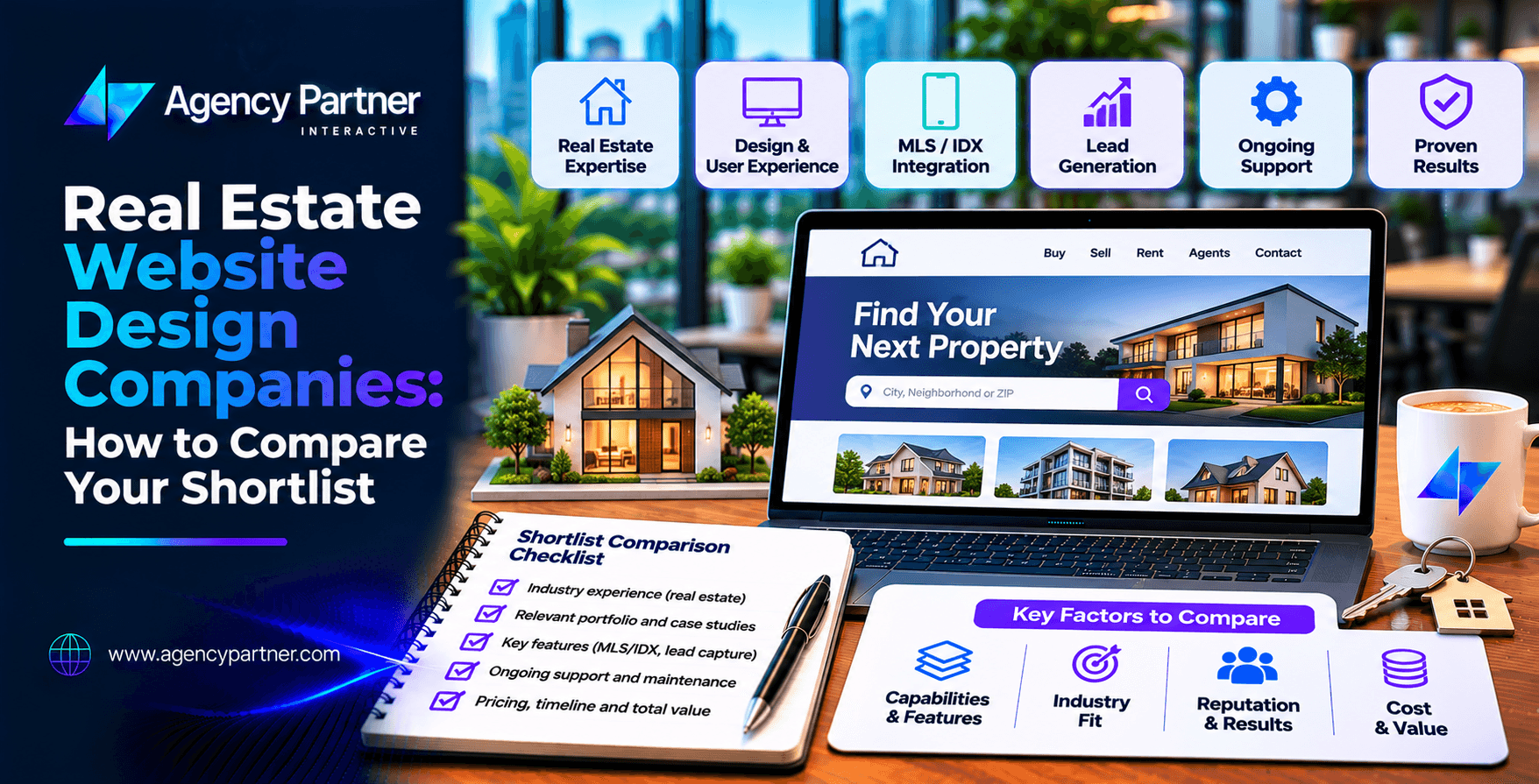
Choosing a website provider is an important decision for any real estate business. Your website needs to showcase properties, attract qualified buyers and sellers, and help your agents manage inquiries without creating unnecessary work.
However, comparing real estate website design companies can be challenging because providers offer different solutions. Some agencies build custom websites, while others sell subscription-based platforms with built-in listing search, lead capture, and customer management tools.
A polished design alone does not guarantee that the website will meet your business needs. You also need to consider listing data, mobile usability, CRM connections, ongoing costs, and what happens if you change providers.
This guide explains how to evaluate your options, compare proposals, and select a website partner that supports your brokerage’s long-term goals.
What Should You Look for in a Real Estate Website Design Company?
The right provider should understand how people search for properties and how real estate teams manage leads. This includes creating useful listing pages, simple navigation, and clear ways for visitors to contact an agent.
Strong real estate website design should also support your business model. A solo agent may need a professional website with basic property search, while a large brokerage may require agent profiles, multiple office locations, and advanced lead routing.
Before requesting proposals, define your goals and identify which features are essential. This helps you compare providers based on business requirements rather than appearance alone.
Ask shortlisted companies to demonstrate relevant projects and explain how their solutions handle property listings, mobile search, CRM connections, and future updates.
Custom Design Agency vs. Real Estate Website Platform
One of the first decisions is whether to hire a custom development agency or use a specialized real estate website platform. Both approaches can work, but they offer different levels of flexibility, control, and ongoing management.
Custom Website Design Agencies
Custom agencies develop websites around a business’s specific requirements. They may offer greater flexibility for branding, unique search experiences, third-party integrations, and specialized workflows.
This approach can suit established brokerages that need features beyond standard templates. However, custom development may require a larger initial investment and separate agreements for hosting, maintenance, and listing data.
Real Estate Website Platforms
Platforms such as Luxury Presence, Sierra Interactive, and Placester offer real estate-focused website solutions with varying combinations of templates, listing tools, CRM features, and support.
These platforms can simplify setup and ongoing management, particularly for teams that prefer a packaged service.
However, customization, integrations, and portability depend on the provider and subscription agreement.
Agency vs. Platform Comparison
| Buying criteria | Custom agency | Real estate platform |
| Website design | Greater potential for customization | Templates or managed design options |
| Launch process | Depends on project scope | Often more standardized |
| IDX/MLS features | May require separate integration | May be included or offered as an add-on |
| CRM connection | Can be tailored to requirements | Depends on supported integrations |
| Ongoing costs | Hosting, support, and licenses | Subscription and optional add-ons |
| Portability | Depends on contract and technology | May have platform restrictions |
Neither option is automatically better. The right choice depends on your budget, technical needs, and desired level of control.
Do You Need IDX Integration for Your Real Estate Website?
IDX integration allows eligible real estate websites to display property listing data through approved systems and agreements. It can help visitors search available properties without leaving your website.
However, not every real estate business needs the same listing functionality. An agent who wants to showcase a small collection of properties may have different requirements from a brokerage offering searches across several markets.
Before selecting a provider, confirm which Multiple Listing Service (MLS) organizations you need to access and whether your business is eligible to display their data.
You should also review listing display rules, required attribution, data refresh requirements, and any applicable fees. An agency or platform should explain how IDX integration will work with your website and who will maintain the connection. Do not assume that a provider’s general claim of MLS compatibility means it supports your specific market.
Why Does Mobile Listing Search Matter?
Property buyers often browse listings on their phones while traveling, comparing neighborhoods, or discussing homes with family members. A mobile website should make it easy to search, filter, and review properties without unnecessary steps.
Effective real estate website design prioritizes readable listing details, responsive images, accessible navigation, and simple contact options. Visitors should be able to filter properties by relevant criteria, such as price, location, property type, and bedrooms. If map search is offered, it should remain usable on smaller screens.
When reviewing brokerage websites, test the experience on an actual phone instead of relying only on desktop demonstrations. Try finding a property, viewing its details, and submitting an inquiry. If these tasks are difficult, the website may need improvements before launch.
How Should Your Website Connect With Your CRM?
A real estate website should do more than collect names and email addresses. It should help your team respond to inquiries and understand what prospective clients need. CRM integration connects website forms and lead activity with the systems your agents already use.
For example, when someone requests a property showing, the website should send the inquiry to the appropriate CRM record with useful context. This may include the property’s address or listing ID, the inquiry type, contact details, and the page where the request originated.
Before selecting a provider, confirm whether your CRM is supported and whether additional integration work is required. You should also test how the system handles duplicate contacts, communication preferences, and failed submissions.
How Should Real Estate Leads Be Routed?
Lead routing determines which agent receives an inquiry and what happens next. For smaller teams, all inquiries may go to one shared inbox. Larger brokerages may need assignments based on location, property type, agent availability, or existing client relationships.
A well-designed process should prevent inquiries from being lost or assigned to the wrong person. For example, a buyer requesting a showing in Dallas could be routed to an available agent responsible for that market. The CRM should record the assignment and create a follow-up task when appropriate.
Your provider should also explain what happens if the assigned agent does not respond. When comparing real estate website design companies, ask for a live demonstration of the complete process, from form submission to CRM assignment. This gives you stronger evidence than a proposal that simply lists lead generation as an included feature.
Who Owns the Website and Customer Data?
Real estate website ownership is one of the most important issues to clarify before signing an agreement. Your business should understand who controls the domain, hosting account, website content, customer records, and any custom-developed features.
Some platforms provide access to a hosted website without transferring ownership of the underlying software. Custom agencies may offer different ownership arrangements depending on their contracts.
Neither model should be assumed to provide unrestricted control. Ask whether you can export website content, contact records, and relevant design assets. Confirm which files or features remain the provider’s property.
Your contract should also explain how access is managed and what happens when the relationship ends. Clear real estate website ownership terms help protect your business from unexpected restrictions during future changes.
What Are the Real Costs of a Real Estate Website?
Website pricing includes more than the initial design or monthly subscription. A custom website may require separate spending on development, hosting, maintenance, integrations, and technical support. A subscription platform may combine several services into one payment but charge additional fees for premium features or higher usage.
When comparing brokerage websites, request a complete cost breakdown covering both launch and ongoing operations. Ask about MLS data access, listing tools, CRM integrations, additional agent accounts, content updates, and cancellation fees.
A practical approach is to compare the expected total cost over three years, using the same assumptions for every provider. This makes it easier to identify whether a lower starting price creates higher costs later.
What Happens if You Switch Website Providers?
Changing providers can affect your website content, search visibility, lead records, and listing functionality. Before signing, ask what you can transfer and what may need to be rebuilt. For example, your domain may be transferable while a proprietary website template or search system is not.
You should also confirm whether customer records can be exported in a usable format and whether important website URLs can be preserved. If your new provider requires a different listing connection, the migration may involve additional setup and approval.
Clear documentation of IDX integration and data dependencies can reduce disruption during the transition. Review real estate website ownership and exit terms before committing, rather than waiting until you decide to move.
How to Compare Real Estate Website Design Companies Fairly
A structured scorecard makes provider comparisons more transparent. Instead of relying on sales presentations or portfolio images, score each company against the same requirements.
Real Estate Website Provider Scorecard
| Evaluation criteria | Weight | What to evaluate |
| Listing search and MLS compatibility | 25% | Data access, search features, compliance |
| Mobile usability and design | 20% | Navigation, speed, property pages |
| CRM and lead routing | 20% | Integrations, assignments, tracking |
| Ownership and portability | 20% | Data export, domain control, exit terms |
| Pricing and ongoing support | 15% | Total costs, maintenance, service terms |
Score each provider from one to five for every category, then apply the weighting to calculate an overall result. These weights are suggested starting points, not independent rankings of actual companies. Adjust them to reflect your brokerage’s needs.
For example, a large team may place greater importance on CRM workflows, while a boutique luxury agency may prioritize custom design and brand presentation. The best real estate website design companies should be able to demonstrate how their solutions meet your requirements rather than simply promising more leads.
Which Providers Should You Consider?
The Musemind comparison identifies several agencies and platforms serving different parts of the real estate market. Musemind and Cybernautic are examples to research for custom design and specialized functionality. UPQODE and Thrive Agency may be relevant when website development and digital marketing support are both priorities.
Luxury Presence, Sierra Interactive, and Placester are examples of real estate-focused platforms worth evaluating for managed website features and lead management. These are examples for building a shortlist, not a verified ranking or endorsement. Features, pricing, and contract terms should be confirmed directly with each provider. A strong shortlist usually includes providers with different delivery models so you can compare the trade-offs before making a final decision.
How Agency Partner Interactive Can Help
Your real estate website should support the way your business manages listings, communicates with clients, and generates opportunities. Agency Partner Interactive offers real estate website design services for businesses seeking responsive websites, custom functionality, and digital experiences aligned with their goals.
Whether you operate an independent agency or manage a growing brokerage, the first step is understanding your website requirements and existing systems. Discuss Your Listings, CRM, and Lead Routing Requirements. Share your listing sources, preferred CRM, website goals, and current challenges with Agency Partner Interactive. Our team can discuss the development approach and integrations that may fit your business.
Final Thoughts
Choosing among real estate website design companies requires more than comparing templates and visual portfolios. Your website should support accurate listings, simple mobile searches, reliable lead routing, and a clear path for future growth.
Evaluate both custom agencies and specialized platforms using the same criteria. Confirm ownership, recurring costs, and migration options before signing. A thoughtful comparison helps you choose a website solution that serves your business today without limiting your options tomorrow.
Frequently Asked Questions
-
Do real estate websites need IDX integration?
Not every website needs IDX. It depends on whether your business wants to display searchable MLS listings and has the necessary access rights. Confirm requirements with your MLS and prospective website provider.
-
Who owns a real estate website and its data?
Ownership depends on your contract and technology platform. Your business should clarify control of the domain, content, customer records, design assets, and software before signing, including which items can be transferred.
-
How are website leads routed to real estate agents?
Leads can be assigned through CRM rules based on location, property interest, availability, or existing relationships. The system should record assignments and provide a clear process for handling unanswered inquiries.
-
What happens if I switch real estate website providers?
You may need to transfer your domain, export customer records, move content, and reconnect listing data. Some proprietary features may not transfer, so review portability and cancellation terms before selecting a provider.
-
Is a custom real estate website better than a platform?
A custom website may offer greater flexibility, while a specialized platform can simplify setup and ongoing management. The better option depends on your budget, integrations, ownership requirements, and plans for growth.
-
How much should a real estate website cost?
Costs depend on design complexity, listing features, CRM connections, hosting, and support. Compare setup fees and recurring expenses over several years rather than choosing a provider based only on its advertised starting price.