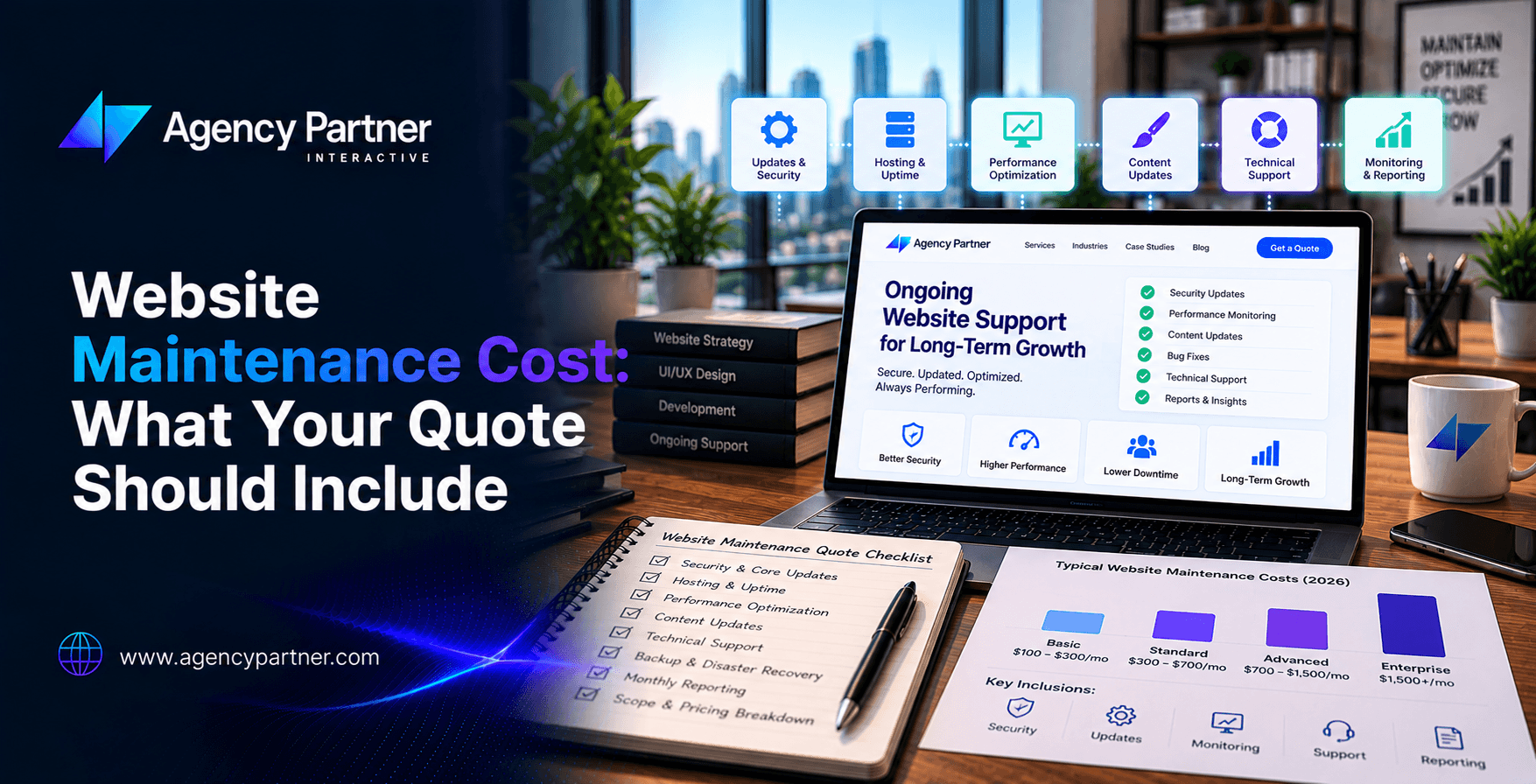
Most businesses budget carefully for their website build. Then they get surprised six months later when the ongoing bill arrives. Here’s a number worth knowing before that happens: over five years, website maintenance typically exceeds the original build cost by 20–40%. Hosting, security patches, software updates, and content changes are not one-time expenses. They compound, every month, every year.
The good news: website maintenance pricing is predictable once you understand what it covers. This guide breaks down what a solid maintenance quote should include, what it should cost by site type, and what to watch out for when you’re comparing proposals.
How Much Does Website Maintenance Cost in 2026?
Website maintenance cost in 2026 ranges from $20/month to $25,000+/month, depending on your site type, traffic volume, and the level of support included.
Here’s the realistic breakdown by site type:
| Website Type | Monthly Cost | Annual Cost |
| Personal site / blog | $15 – $75 | $180 – $900 |
| Small business website | $50 – $500 | $600 – $6,000 |
| Ecommerce (SMB) | $300 – $1,000 | $3,600 – $12,000 |
| Ecommerce (enterprise) | $800 – $5,000+ | $9,600 – $60,000+ |
| Custom web application | 15–25% of build cost/year | varies |
| Enterprise corporate site | $2,000 – $25,000+ | $24,000 – $300,000+ |
These are not arbitrary ranges. They reflect real differences in what it takes to keep a site secure, fast, and functional at each level of complexity.
What Should a Website Maintenance Quote Actually Include?
This is the question most buyers don’t know to ask. A quote that just says “$199/month, website maintenance” tells you almost nothing. Here are the five core services that every professional maintenance plan should cover, and what’s typically not included unless you ask.
1. Hosting
Hosting is the cost of keeping your site live on a server. It’s the most basic ongoing website expense, and the one most often bundled into maintenance plans without being itemized.
What to expect:
- Shared hosting: $5–$15/month (fine for low-traffic sites)
- VPS or managed hosting: $20–$80/month (most business sites)
- Dedicated or cloud hosting: $100–$500+/month (high-traffic or ecommerce)
Ask your provider which hosting tier is included. Shared hosting on a cheap plan often leads to slow load times, which directly affects SEO and user experience. If your maintenance quote includes hosting, confirm the specs.
2. Security Monitoring and Updates
This is the most critical component of any maintenance plan, and the one most likely to be vague in a low-cost quote.
What proper security maintenance includes:
- Daily or continuous malware scanning
- Firewall configuration and monitoring
- SSL certificate management (renewal and installation)
- Software updates, CMS core, themes, and plugins for WordPress; platform updates for Shopify or custom builds
- Brute force protection and login security
What it costs when skipped: A hacked website costs an average of $4,200 to remediate, plus the damage to customer trust and SEO rankings. Google delists compromised sites. Recovery takes weeks. A $150/month maintenance plan that includes security monitoring costs $1,800/year. That’s cheap insurance.
3. Backups
Backups should be automatic, frequent, and stored offsite. If your server goes down and your only backup is on the same server, you have no backup.
What to look for:
- Daily backups as a minimum (more frequent for ecommerce)
- Offsite storage (cloud-based, not on the same server)
- Documented restore process, not just a backup that nobody has tested
Most managed hosting includes basic backups. Confirm the retention period (how far back can you restore) and the restore process (how fast can they get you back up if something breaks).
4. Performance Optimization
Slow sites lose visitors. A one-second delay reduces conversions by 7%. Performance maintenance includes:
- Image compression and optimization
- Caching configuration and updates
- Database cleanup (for WordPress sites especially)
- Core Web Vitals monitoring, LCP, CLS, and INP
- CDN (Content Delivery Network) management for faster global load times
This is often missing from entry-level maintenance plans. If your quote doesn’t mention performance, ask about it. A site that passes Core Web Vitals ranks better on Google and converts more visitors.
5. Content Updates and Technical Support
This is where website support costs vary the most between providers, and where hidden charges appear.
Two models exist:
Hours included: Some maintenance plans include a set of content-change hours per month, typically 1–4 hours. Content updates, text changes, new pages, and image swaps happen within that allocation.
Hourly billing for extras: Most plans bill additional work at an hourly rate. WebFX charges $150/hour for work outside the plan. Industry standards run $75–$200/hour depending on the provider.
What to confirm before signing:
- How many content-change hours are included?
- What is the hourly rate for work outside the plan?
- Are emergency fixes (site down, broken checkout) included or billed separately?
- What is the response time for urgent issues?
Website Maintenance Pricing by Platform
Different platforms have different ongoing website expenses. Here’s what to expect:
WordPress
WordPress sites require the most active maintenance. Every plugin is a potential security vulnerability when left unupdated. The more plugins, the more update testing required.
Monthly cost: $75–$500/month for most business WordPress sites. The primary cost driver is plugin count and frequency of content changes.
Shopify
Shopify handles most platform-level maintenance (security, hosting infrastructure, core updates) within its subscription fee. Your maintenance costs focus on theme updates, app compatibility, and custom code.
Monthly cost: $200–$1,000/month for most Shopify stores, depending on the complexity of custom features and app integrations.
Custom-Built Websites
Custom sites require developer involvement for most maintenance tasks, there’s no dashboard for updating a plugin. Maintenance is typically priced as a developer retainer.
Monthly cost: $1,000–$10,000+/month, or 15–25% of the original build cost per year as a rule of thumb.
What’s Usually NOT Included (But Should Be on Your Radar)?
Even well-priced maintenance plans have exclusions. Here’s what commonly falls outside the scope and gets billed separately:
Emergency fixes outside business hours If your site crashes at 11 PM on a Friday before a big campaign, most standard plans don’t cover emergency after-hours support. Ask whether 24/7 support is available and at what cost.
- Major redesigns or new functionality: A new landing page, a checkout redesign, or a new feature integration is development work, not maintenance. These are scoped and priced separately.
- Third-party tool changes: When a payment gateway, CRM, or API changes its integration requirements, the update work on your site isn’t always covered under a standard maintenance plan.
- Domain renewal: Domain registration is often excluded from maintenance bundles. It runs $10–$130/year, depending on the TLD (.com, .co, .io). Set a calendar reminder. A lapsed domain takes your entire site offline.
DIY vs. Freelancer vs. Agency: What’s the Right Choice?
| Option | Monthly Cost | Pros | Cons |
| DIY (manual) | $20–$50 | Cheapest | Your time, your risk |
| Automated tools | $20–$100 | Low cost, hands-off basics | No support when things break |
| Freelancer retainer | $50–$150 | Personal relationship | Single point of failure |
| Agency managed plan | $95–$500+ | Full coverage, documented SLA | Higher cost |
For most business owners, the DIY option is a false economy. Maintenance requires consistent attention, software updates can’t wait three months, and security scans need to run automatically. When something breaks on a DIY plan, the cost of hiring someone to fix it often exceeds months of agency fees.
What a Fair Quote Looks Like
For a standard small business website, a professional maintenance plan in 2026 should cost $95–$200/month and include:
- Managed hosting with appropriate server specs
- Automated daily backups stored offsite
- Continuous security scanning and malware removal
- SSL certificate management
- Uptime monitoring with alert notifications
- 1–2 hours of content changes per month
- Monthly or quarterly reporting on site health
- Defined response time for support requests
If a quote is below $50/month and claims to include all of this, something is missing. If it’s above $500/month for a simple business site, ask for a full scope breakdown.
Agency Partner Interactive offers web development services that include post-launch maintenance planning from the start, so the ongoing cost is clear before the project closes, not after. If you’re reviewing a maintenance proposal or planning for a new build, our team can help you understand what you actually need. Talk to us.
FAQs
-
How much does website maintenance cost per month in 2026?
Most small business sites cost $50–$500/month. Ecommerce stores run $300–$1,000/month. Enterprise sites can reach $25,000+/month. The range depends on site complexity, platform, and support level.
-
What does website maintenance include?
Core maintenance covers hosting, security monitoring, backups, software/plugin updates, performance optimization, and a set number of content-change hours per month.
-
What are ongoing website expenses I should budget for?
Domain renewal ($10–$130/year), hosting ($5–$500/month), SSL, security tools, backups, plugin/platform updates, and content management hours are the primary recurring costs.
-
Is website maintenance worth it for small businesses?
Yes. A hacked site costs $4,200+ to remediate on average. A site that goes down during a campaign loses sales. A $150/month maintenance plan is cheap compared to those outcomes.
-
How much does WordPress maintenance cost?
WordPress maintenance runs $75–$500/month for most business sites. The main cost driver is plugin count, more plugins mean more update testing and more potential security vulnerabilities.
-
How do I know if a maintenance quote is fair?
A fair quote for a standard small business site is $95–$200/month and should itemize hosting, backups, security, updates, uptime monitoring, content-change hours, and support response times. Ask for a line-by-line scope if anything is vague.