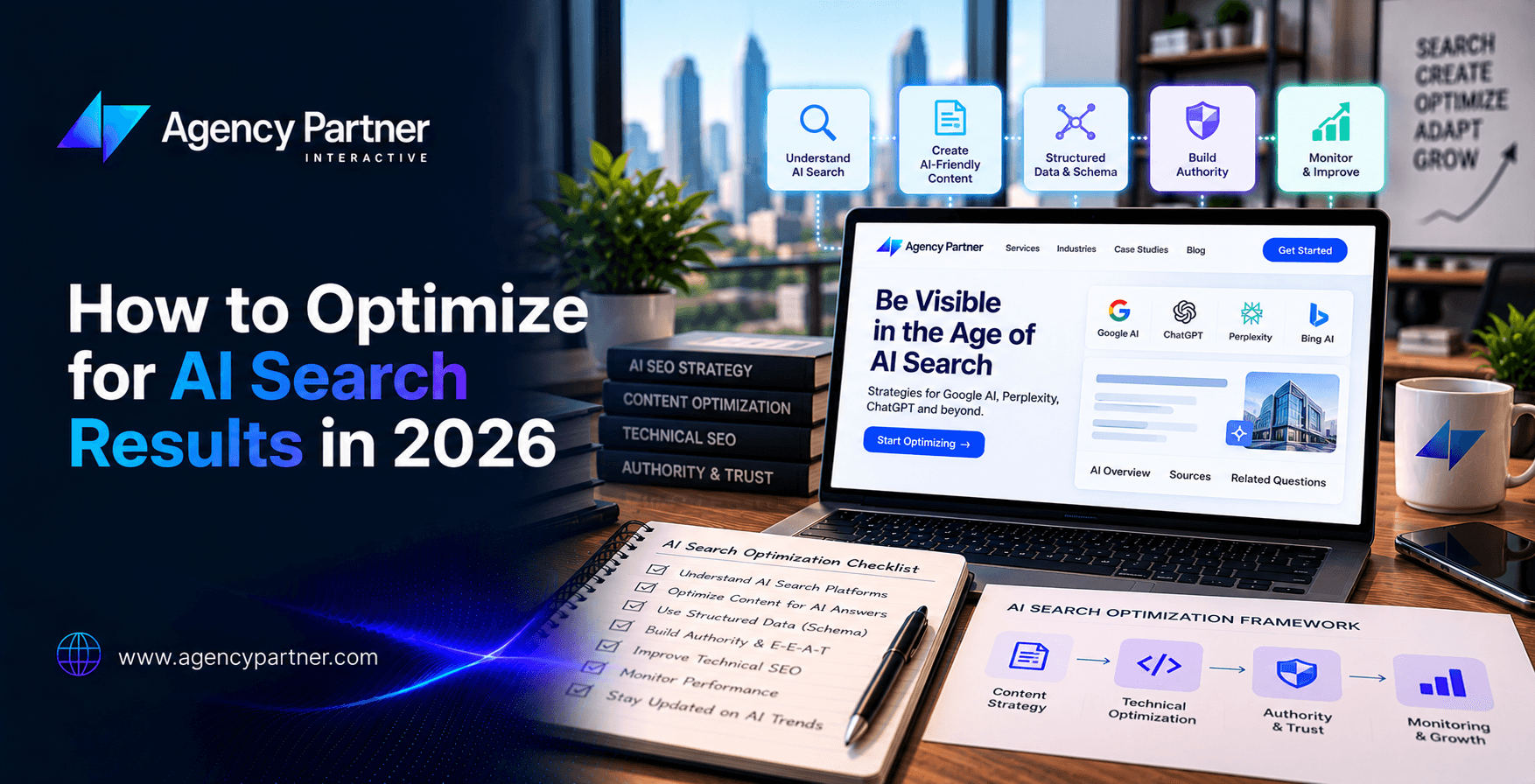
Most businesses are optimizing for Google. But a growing share of their audience isn’t using Google anymore. They’re asking ChatGPT. They’re using Perplexity. They’re getting answers from Google’s AI Overviews. And here’s the number that should matter most to you: visitors from AI search convert 4.4 times better than visitors from organic search.
That’s not a soft engagement metric. That’s purchase behavior. By the time someone finds you through an AI citation, they’ve already been given context, compared alternatives, and made a shortlist. They arrive closer to buying.
AI search optimization, also called generative engine optimization (GEO), is the practice of getting your content cited and recommended by AI systems. This guide covers exactly how to do it, how to measure it, and what most businesses are getting wrong.
What Is AI Search Optimization, and How Is It Different From SEO?
Seo artificial intelligence and traditional SEO share the same DNA. But they have a different goal.
Traditional SEO: get your page to rank in search results so users click through to your site.
Ai search engine optimization: get your content cited in AI-generated answers so users trust your brand, whether or not they click.
The shift matters because AI systems don’t link to ten results. They synthesize an answer from several sources and cite the ones they find most credible, specific, and well-structured. Being in position three is no longer enough if an AI Overview answers the question before anyone scrolls.
16% of all Google searches now show AI Overviews. ChatGPT now has over 200 million weekly active users. Perplexity handles billions of queries per month. These aren’t niche products, they’re mainstream search behavior.
Step 1: Make Sure AI Systems Can Actually Access Your Site
This is the most overlooked step in artificial intelligence for seo. Many businesses are blocking AI crawlers by accident, and wondering why they never appear in AI answers.
Open your robots.txt file at yoursite.com/robots.txt. Look for any Disallow: / rules that apply to:
- GPTBot, OAI-SearchBot, ChatGPT-User: OpenAI’s crawlers for ChatGPT
- ClaudeBot, Claude-User: Anthropic’s crawlers for Claude
- CCBot: Common Crawl, used by multiple AI training pipelines
- PerplexityBot: Perplexity’s crawler
If any of these are blocked, remove the restriction. You cannot get traffic from ai search if the AI systems are not allowed to read your content.
Beyond robots.txt, check for:
- Login walls or paywalls on key content pages
- JavaScript-heavy navigation that crawlers can’t follow
- Pages that load slowly enough to be skipped by crawlers
- Missing or broken canonical tags pointing to wrong URL versions
Quick test: Search your brand name on ChatGPT, Perplexity, and Claude. If you never appear as a cited source on topics you cover, there’s likely an access issue, or a content gap.
Step 2: Structure Content for AI Extraction
Artificial intelligence search engine optimization rewards a specific type of content structure. AI systems extract chunks, not whole pages. They need each section to be self-contained and directly answerable.
- Use Question-Format Headings: Instead of “Our Approach to Email Marketing,” write “How Does Email Marketing Work for B2B Companies?” The heading tells the AI exactly what question this section answers.
- Open Every Section with a Direct Answer: Don’t build up to the point. State it first. Then expand. This is how AI systems pull quotable content, they look for the answer before the explanation, not after.
- Use Specific Numbers and Named Sources: Vague statements get passed over. Specific claims get cited. “Email conversion rates improved by 34% within 60 days after implementing automated segmentation” is more useful to an AI than “Email performance improved significantly.”
- Add FAQ Sections: FAQ schema maps questions to answers in a format AI systems read easily. A well-built FAQ section can appear verbatim in AI Overviews and ChatGPT responses.
Step 3: Build Entity Authority Off Your Site
Artificial intelligence in ecommerce and AI search both operate on the same trust signal: what the rest of the web says about you.
AI systems evaluate your brand using both on-site signals (what you say about yourself) and off-site signals (what others say about you). A brand with zero external mentions is harder to cite confidently, regardless of how good the on-site content is.
How to improve brand visibility in ai search through off-site authority:
- Earn Citations in Industry Publications: Guest articles, press mentions, and expert quotes in credible outlets all strengthen your entity presence. When multiple authoritative sites reference the same brand in the same context, AI systems develop higher confidence in that brand’s expertise.
- Build a presence on community platforms: Reddit, Quora, LinkedIn, and industry forums are increasingly cited by Perplexity and ChatGPT. Genuine, helpful answers on these platforms, without self-promotion, build brand association with specific topics.
- Keep Google Business Profile and Wikipedia accurate: AI systems cross-reference these sources. Inconsistent or outdated information creates noise in how your brand gets described.
- Pursue Subject Matter Expert Quotes: When your team members are quoted in third-party articles, that attribution builds authority that an AI can trace back to your brand.
Step 4: Optimize for Different AI Platforms Differently
Each AI platform retrieves content from a different source. Artificial intelligence seo strategy should account for these differences.
| Platform | How It Retrieves Content |
| Google AI Overviews | Google’s search index, traditional SEO ranking still matters |
| ChatGPT | Training data + Bing index (when web search is on) |
| Perplexity | Its own search index via real-time web crawl |
| Claude | Training data + Brave Search index (when web search is on) |
| Gemini | Training data + Google’s search index |
This means ai search engine optimization is not one-size-fits-all. To appear in Google AI Overviews, standard technical SEO still matters. To appear in ChatGPT and Claude, your content needs to be publicly accessible and well-indexed by Bing and Brave. To appear in Perplexity, real-time crawlability is critical.
Practical takeaway: Run the same query across all five platforms. Note which competitors appear in each one. Optimize for the platforms where you have the biggest gaps.
How to Track Brand Mentions in AI Search
How to track brand mentions in ai search is one of the most searched questions in this space, because the answer isn’t obvious.
Free manual methods:
- Search your brand name + key topics on ChatGPT, Perplexity, Claude, and Gemini once per week. Note when you’re cited and when you’re not.
- Search the questions your audience is most likely asking. Note which competitors get recommended. This tells you both your citation gaps and your content gaps.
- Set up Google Alerts for your brand name. Some AI-cited content generates downstream mentions that surface in alerts.
How to track ai search engine citations with tools:
- Semrush AI Visibility Toolkit: Tracks citation frequency across AI platforms, benchmarks against competitors, and surfaces trends over time
- Brandwatch: Monitors AI platform outputs for brand mentions at scale
- Ahrefs AI visibility reports: Emerging feature tracking where content gets cited in AI responses
- Manual prompt testing spreadsheet: The simplest approach: a shared Google Sheet where your team logs weekly prompt tests, which platforms cited you, and which cited competitors
How to measure ai search visibility without a paid tool: track the percentage of your core topic prompts where you appear as a citation. If you run 20 prompts per week and appear in 4, your citation rate is 20%. Track this weekly. Improvement is slow but measurable.
Common Mistakes That Kill AI Search Visibility
Why choose ai search visibility platforms over manual methods? Because these mistakes are easy to miss without tracking:
- Accidentally Blocking AI Crawlers: Already covered, but it’s the #1 silent killer of AI visibility.
- Publishing Thin, AI-generated Content: AI systems prefer citing content that offers unique perspective, original data, or first-hand experience. Content that was clearly written by AI without human expertise rarely gets cited by AI. The bar is higher than it looks.
- Not Updating Old Content: ChatGPT prioritizes recent content. An excellent guide from 2022 loses citations to mediocre content published last month. Set a quarterly calendar to update your highest-traffic pages with new statistics, updated examples, and current dates.
- Treating AI Search as Separate from SEO: They’re not separate disciplines. Strong traditional SEO, high-quality content, authoritative backlinks, technical health, is still the foundation. AI search optimization layers on top of it, not instead of it.
- Optimizing for one platform only: ChatGPT and Perplexity pull from different indexes. Google AI Overviews weighs traditional ranking signals. Ignoring one platform leaves a significant share of AI-referred traffic on the table.
Working With Agencies Who Specialize in AI Search Optimization
Agencies who specialize in ai search optimization are a growing category. Here’s what to look for when evaluating one.
They should be able to show you:
- Which AI platforms they track and how they measure citation frequency
- Examples of clients whose brand visibility in AI search improved, with before/after data
- A clear workflow for content structuring, schema implementation, and off-site entity building
- Fluency in both traditional SEO and GEO, not just one
Be skeptical of agencies that claim they can “guarantee” AI citations. AI systems change their retrieval behavior frequently. There are no guarantees. The right agency builds the conditions for citation, through content quality, entity authority, and technical access, and measures results honestly over time.
Agency Partner Interactive builds ai search optimization strategies for businesses that want to appear in AI-generated answers, not just search rankings. Our approach combines technical SEO, content restructuring, and off-site authority building to improve how AI systems understand and cite your brand. Talk to our team.
FAQs
-
What is AI search optimization?
It’s the practice of getting your content cited in AI-generated answers from systems like ChatGPT, Google AI Overviews, and Perplexity, rather than just ranking in traditional search results.
-
How is AI search optimization different from traditional SEO?
Traditional SEO aims to rank your page for clicks. AI search optimization aims to get your content cited in AI responses, which builds brand authority even when users don’t click through to your site.
-
How do I track brand mentions in AI search?
Manually search your brand name and core topics weekly across ChatGPT, Perplexity, Claude, and Gemini. Log citations and track your citation rate over time. Tools like Semrush’s AI Visibility Toolkit automate this at scale.
-
How do I get traffic from AI search?
Make sure AI crawlers can access your site via robots.txt, structure content with question-format headings and direct answers, add sourced statistics, build off-site entity authority, and keep content updated, especially pages covering high-volume topics in your industry.
-
How do I improve brand visibility in AI search?
Earn citations in credible third-party publications, contribute expert quotes to industry coverage, build a presence on community platforms like Reddit and Quora, and ensure your Google Business Profile and brand listings are accurate and consistent across the web.
-
Why do AI search visitors convert better than organic search visitors?
By the time someone finds your brand through an AI citation, the AI has already provided context, compared alternatives, and validated your solution. They arrive at your site further along in their decision-making process, making them more likely to convert.