More than 70,000 health-related Google searches happen every minute. The average patient visits 5.4 different websites before choosing a provider. And 80% of patients now begin their provider search on Google or an AI assistant before they ever call an office.
Healthcare is a high-trust decision. But the trust-building process has moved online, completely. Providers that understand this are growing. Those still relying on referrals and traditional advertising alone are losing ground, quietly, to competitors they may not have considered a threat.
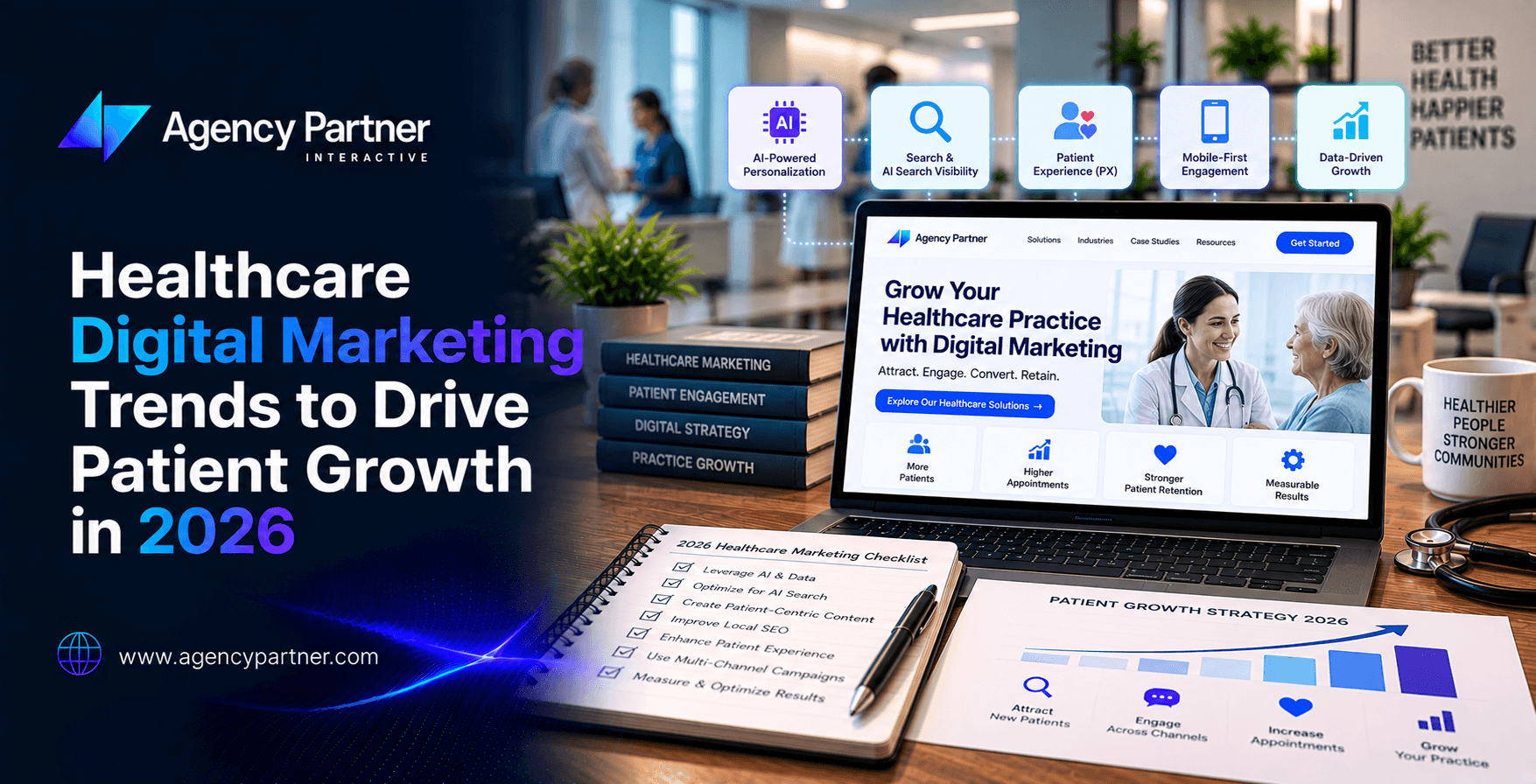
The healthcare digital marketing landscape in 2026 has shifted in ways that directly affect how patients find you, evaluate you, and decide whether to book. This guide covers the trends that are actually moving patient acquisition numbers, and what each one means for your practice or health system.
Trend 1: AI Search Is Now the Starting Point for Patient Decisions
Digital marketing in healthcare has always been SEO-driven. That’s not changing. But where patients search has changed significantly.
AI Overviews now appear on roughly 16% of Google searches. ChatGPT, Perplexity, and Google’s AI Mode are increasingly used for health-related queries. A patient searching “best cardiologist in Dallas” is as likely to get an AI-generated summary as a traditional list of results.
What this means practically: healthcare organizations with structured data see 15–25% better AI citation visibility compared to plain-text sites. Providers without FAQ-style content, schema markup, and clearly structured service pages are invisible in these AI-generated answers.
The action: Structure your most important service pages to answer specific patient questions directly. Add FAQ schema. Keep content updated, AI systems favor recent content over older evergreen pages that haven’t been refreshed.
Trend 2: Online Reviews Are the Conversion Mechanism
96% of patients say online reviews influence their choice of provider. That number has held near the top of every patient behavior survey for three years. What’s changed is how reviews are being used.
In 2026, review recency outweighs review quantity. A practice with 200 reviews and no new ones in six months loses ground to a competitor with 80 reviews and four added this month. AI systems and Google’s local ranking algorithm both weight freshness heavily.
89% of healthcare patients use online reviews to evaluate providers before booking. And 75% of patients rely on online reviews as the first step to finding a doctor. Your Google Business Profile is no longer a backup channel. It’s the first impression for most new patients.
The action: Build a systematic review generation process. Ask every patient at checkout or via a post-visit text. Respond to all reviews, positive and negative, within 48 hours. Flag HIPAA compliance in any response that might reference patient details.
Trend 3: Self-Scheduling Is a Patient Acquisition Tool
Only 24% of healthcare appointments in the US are scheduled online. That gap is one of the biggest untapped conversion opportunities in digital marketing healthcare.
Nearly half of online bookings happen after business hours, when your front desk isn’t available. Practices without self-scheduling lose high-intent patients at the exact moment they’re ready to book. They came through your SEO or paid search. They found your reviews compelling. And then they hit a “call us to schedule” wall.
Practices offering self-scheduling see a 20–30% lift in new patient conversions. Mobile-friendly design alone boosts patient call inquiries by 32%.
The action: Implement real-time online self-scheduling on every service-specific landing page. Make it mobile-first. Connect it to your EMR so availability is live. Track it as a conversion event in Google Analytics to measure ROI from digital campaigns.
Trend 4: Video Content Is Your Highest-Engagement Asset
88% of patients prefer video content over text when researching healthcare providers. Video content boosts patient engagement by 49%. On social media, video drives dramatically higher reach than any other format across every platform.
This is not about production value. Patients respond well to authentic, direct-to-camera content from providers. A 90-second video where a physician explains a procedure outperforms a polished ad in trust and watch-through rates.
TikTok healthcare content views are up 150% year-over-year, with Gen Z engagement at 78%. YouTube healthcare channels are growing. Even a short-form video series on Instagram or Facebook, one question answered per week, builds the kind of familiarity that converts a prospective patient browsing five providers into one who books with you.
The action: Film short videos (60–120 seconds) of your providers answering the most common patient questions. No script required, authenticity is the asset. Post consistently across YouTube, Instagram, Facebook, and TikTok. Caption every video.
Trend 5: Personalization- Done Right Within HIPAA Boundaries
78% of patients expect personalized communications from their healthcare providers. But 63% are concerned about how their health data is used online. This is the tension every healthcare marketer has to navigate. Personalization works. Personalization without compliance destroys trust, and creates legal exposure.
The digital marketing strategy for healthcare that wins in 2026 is personalized by segment, not by individual health data. Segment patients by age group, service line interest, or referral source, all of which can be done without touching PHI. Personalized emails based on these segments increase patient retention by 22% and open rates by 26%.
HIPAA-compliant marketing automation is growing rapidly. Platforms like Klara, Relatient, and Healthgrades offer compliant patient communication tools that allow personalization within legal boundaries.
The action: Segment your email and SMS communications by service line and patient lifecycle stage (new patient, post-visit, lapsed). Personalize the messaging, not the health data. Get explicit consent before any patient data enters a marketing workflow.
Trend 6: Telehealth Is a Permanent Patient Acquisition Channel
Telehealth adoption grew 38x compared to pre-2020 levels. Telehealth patient satisfaction sits at 94%. And marketing is driving 42% of telehealth adoption, meaning patients are discovering virtual care through ads and content, not just through their existing providers.
The mistake most organizations make in hospital marketing trends: treating telehealth as a pandemic-era workaround rather than a permanent service line with its own marketing infrastructure. Telehealth needs its own landing pages, booking flows, paid search campaigns, and performance dashboards.
Practices that offer both in-person and telehealth options, and let patients choose at the moment of booking, convert more first-time patients than in-person-only competitors. The low-barrier virtual entry point converts hesitant prospects into long-term patients.
The action: Build a dedicated telehealth landing page for each major service line you offer virtually. Run specific paid search campaigns targeting telehealth-intent queries. Set up a separate conversion funnel with its own attribution in your analytics.
Trend 7: AI-Driven Marketing Tools Are Lowering Patient Acquisition Costs
The average cost per lead in healthcare has settled at $53.53 in 2026. But the gap between organizations using AI-driven marketing tools and those running traditional campaigns is significant and widening.
Healthcare organizations using AI-driven marketing report 27% lower patient acquisition costs and 34% higher appointment completion rates compared to those using traditional digital marketing.
Healthcare technology marketing in 2026 means AI-assisted paid search bidding, predictive patient modeling for audience targeting, and automated chatbots handling intake. Chatbots now handle 68% of initial patient queries and improve satisfaction scores by 31%. The front desk handles the conversations that matter. AI handles the rest.
Organizations using digital marketing overall see a 4.8x return on investment, primarily through patient acquisition.
The action: Audit your current paid search setup. If you’re still doing manual bidding, shift to AI-driven bidding strategies with patient conversion actions as goals. Add a chatbot to your website for after-hours inquiries. Track lead-to-booked-patient rates, not just lead volume.
Trend 8: Omnichannel Is the Strategy- Not Just a Buzzword
The average patient visits 5.4 websites before choosing a provider. They see a social post, read a review, check your website, find you on Google Maps, and follow up with an email. If your messaging is inconsistent across those touchpoints, the trust you built in one channel gets eroded in another.
Healthcare organizations with coordinated omnichannel strategies report 23% higher patient retention rates compared to those with siloed channel management. 54% of all traffic to healthcare websites comes from organic search, but the patient may have seen your Facebook video before they ever searched.
The winning digital marketing in healthcare industry approach connects every channel under one consistent patient experience. Same brand voice. Same patient promise. Same follow-up quality. Regardless of where the patient first found you.
The action: Map your patient acquisition journey by service line. Identify where channels hand off, from paid search to website to booking to follow-up, and ensure the experience is consistent and uninterrupted across every step.
Agency Partner Interactive works with healthcare organizations, specialty practices, and health technology companies to build digital marketing strategies that drive measurable patient growth. From AI search visibility to HIPAA-compliant marketing automation, our team understands the specific constraints and opportunities of healthcare digital marketing. Talk to us about your 2026 growth goals.
FAQs
-
What are the biggest healthcare digital marketing trends in 2026?
AI search optimization, online reputation management, self-scheduling conversion, short-form video, HIPAA-compliant personalization, telehealth marketing, and AI-driven paid search are the eight trends with the strongest patient acquisition data behind them.
-
How does digital marketing help healthcare patient growth?
Digital marketing brings patients in at every stage of their decision journey, from first awareness through search and social, to evaluation through reviews and website content, to conversion through online booking. Organizations investing in digital see a 4.8x ROI on patient acquisition.
-
What is digital marketing strategy for healthcare providers?
It’s a coordinated plan that covers SEO, paid search, content marketing, social media, online review management, email/SMS patient communications, and telehealth promotion, all designed within HIPAA compliance boundaries and tracked to patient revenue outcomes.
-
How important are online reviews for healthcare marketing?
Critical. 96% of patients say reviews influence their provider choice, and 75% use reviews as their first step in finding a doctor. Review recency now matters more than quantity, fresh reviews in 2026 outweigh a large volume of old ones.
-
How can healthcare organizations use AI in digital marketing?
AI is being used for predictive patient targeting in paid search, AI-driven chatbots for after-hours patient inquiries, automated appointment reminders, answer engine optimization for AI search visibility, and HIPAA-compliant personalization in email and SMS campaigns.
-
What are the best digital marketing channels for hospitals in 2026?
Organic search (54% of healthcare website traffic), Google Business Profile and reputation management, short-form video (YouTube, TikTok, Instagram), HIPAA-compliant email and SMS, paid search with AI bidding, and telehealth-specific landing pages are the highest-performing channels for hospital patient acquisition.