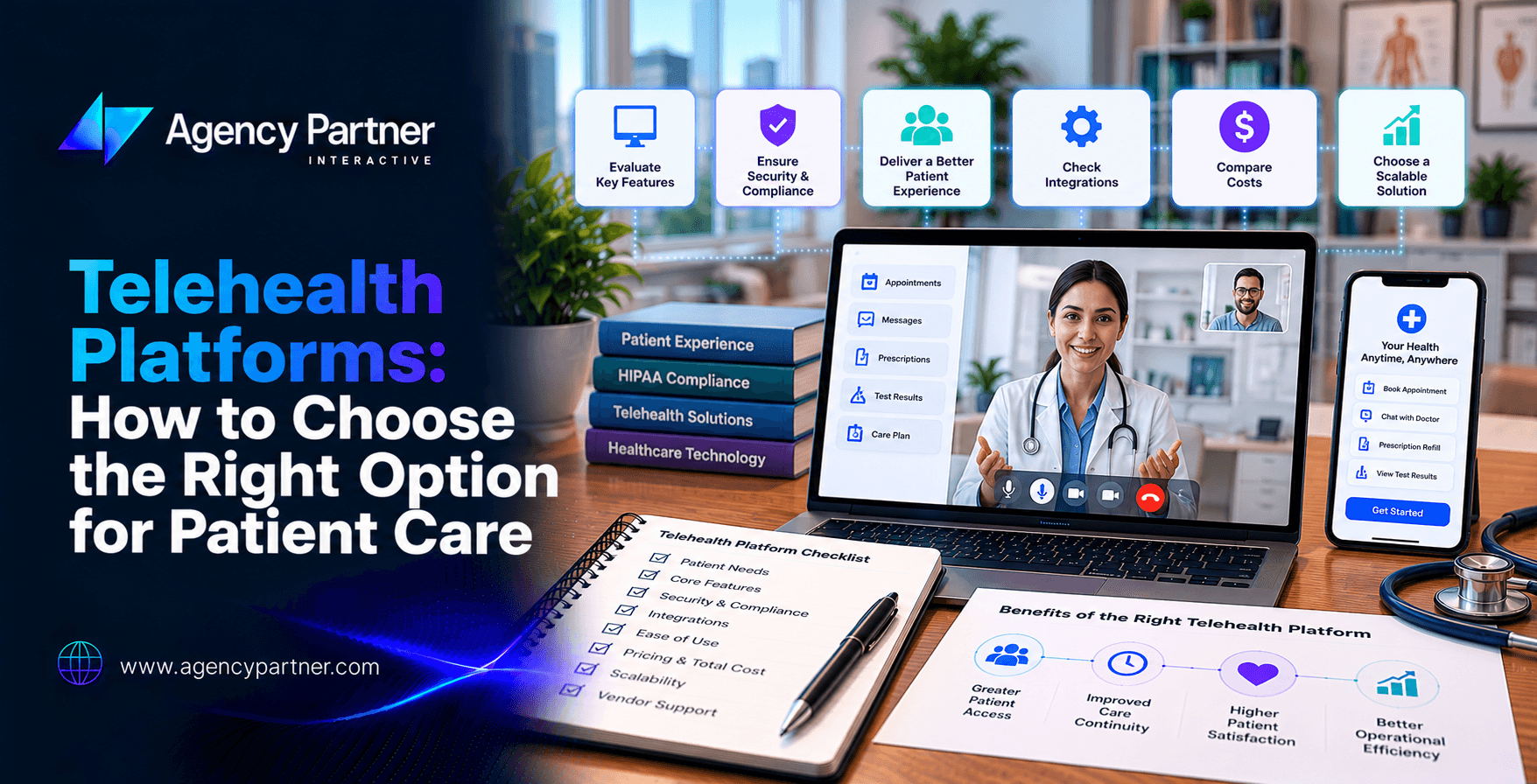
Choosing between telehealth platforms starts with a practical question: do you need software for your clinicians, a partner that delivers virtual care, or a combination of both? A video consultation tool and a contracted care network solve different problems, even when both are described as telehealth.
For a healthcare practice, the right choice should fit appointment workflows, patient access, privacy requirements, and the systems staff already use. This guide compares several options by their role, then explains what to test before signing a contract.
Research note: Vendor descriptions were reviewed against official documentation on October 23, 2026. This is a procurement guide, not a hands-on product ranking. Availability, plan features, and contract terms need confirmation with each vendor.
What are telehealth platforms?
Telehealth platforms support healthcare delivered remotely. Depending on the product, that can include video visits, patient intake, scheduling, communication, documentation, or connections to clinical systems. Some companies also supply clinicians and care programs.
Telemedicine platforms typically focus on remote clinical encounters. Telehealth is a broader term, but vendors use the labels differently. Define your required workflow before using either label to narrow a shortlist.
If you are still deciding which functions belong in your own product, start with these custom healthcare app features. Separate essential clinical workflows from features that would simply be convenient.
Telehealth platform comparison: understand the buying category first
The options below are not ranked from best to worst. Their suitability depends on who delivers care, which systems must connect, and how the service will operate.
| Option | Buying category to investigate | Question to resolve in a demo |
|---|---|---|
| Doxy.me | Healthcare video platform for provider use | Does the selected plan support your actual intake and visit workflow? |
| Amwell | Care delivery platform and programs for healthcare organizations | Which platform modules, clinical services, and integrations are included? |
| Teladoc Health | Virtual care programs and organizational solutions | Are you purchasing technology, care delivery, or both? |
| MD Live | Virtual care partner serving health plans and employers | How do eligibility, clinical coverage, and implementation fit the population? |
| Zoom with an appropriate healthcare agreement | Video communication within a broader clinical workflow | Which services are covered by the agreement, and what must another system handle? |
Doxy.me: investigate when a straightforward video workflow is the priority
Doxy.me describes a browser based experience without patient downloads or logins. Its product includes a waiting room and other clinical workflow features, with availability to confirm for the selected plan.
Test the complete encounter rather than stopping after a successful video call. Have a patient join, a staff member manage arrival, and a clinician finish the visit. Identify where consent, notes, payment, and follow-up will live.
Amwell: investigate the specific organizational offering
Amwell markets a care delivery platform alongside clinical programs for payers and healthcare systems. The company name alone does not define the product your organization would purchase.
Request a demonstration built around one service line. Ask the vendor to identify the included modules, implementation responsibilities, ongoing support, and any separately contracted services. A broad portfolio is useful only when the relevant pieces work together for your organization.
Teladoc Health: clarify the relationship between technology and care delivery
Teladoc Health’s organizational offerings address employers, health plans, hospitals, and health systems. Its portfolio spans multiple care programs and organizational needs.
Establish whether your requirement is access to a care program, infrastructure supporting your own clinicians, or a combination. Then compare the relevant proposal with alternatives in the same category. A consumer access experience does not establish fit for a provider network’s procurement requirements.
MD Live: evaluate as a virtual care partnership
MD Live’s business offering focuses on virtual care relationships with health plans and employers. That makes eligibility, coverage, care delivery, and implementation central buying questions.
For an independent practice seeking software for its existing team, first confirm whether the proposed arrangement actually addresses that need. For a benefits or health plan buyer, examine how members discover the service and move between virtual care and other care settings.
Zoom: evaluate video capabilities within the whole care journey
Video communication may be one component of your existing clinical system. Zoom documents Business Associate Agreement eligibility and related requirements. Confirm the applicable agreement and covered services for your account.
Separately establish how your organization will manage appointments, consent, documentation, and patient support. Do not assume a video subscription replaces those functions or resolves every privacy obligation.
How to evaluate telehealth software before you buy
1. Map the current workflow before adding another platform
Start with your current EHR and patient portal. They may already offer capabilities worth evaluating before introducing another system. The HHS guide to getting started with telehealth highlights integration, patient usability, and platform costs as selection considerations.
Write down who owns each handoff: referral, appointment confirmation, identity checks, visit preparation, consultation, documentation, and follow-up. Ask vendors to demonstrate the same scenario so your team can compare answers consistently. For integration planning, this explanation of the role of APIs in web applications provides useful background.
2. Test the patient experience under ordinary conditions
Try the service on the devices and connections patients actually use. Ask someone unfamiliar with the platform to join without coaching. Record confusing steps, failed permissions, and the point at which support becomes necessary.
HHS offers guidance on preparing patients for telehealth technology, including device readiness and practice appointments. Translate preparation instructions into language your patients understand.
Include accessibility and interpreter needs in the evaluation. If patients struggle before reaching the visit, UI UX design services can help assess the interface and joining journey. These improvements should be tested with representative users.
3. Review privacy responsibilities beyond a product claim
Searching for HIPAA compliant telehealth platforms is a reasonable starting point, but a marketing label is not a review of your organization’s workflow. HHS explains that covered providers must use appropriate technology arrangements, including applicable vendor BAAs, in its telehealth technology and HIPAA guidance.
Have the responsible privacy, security, and legal teams review the proposed data flows and agreements. Identify who can access records, how permissions change when staff leave, and how incidents are handled. Review optional recording, transcription, and AI features separately before enabling them.
4. Ask for integration evidence, not an integration logo
A connection listed on a sales page does not tell you what your team will receive. Ask which information moves in each direction, when it updates, and what happens when a transfer fails. Confirm who maintains the connection after either system changes.
Organizations with unusual workflows can scope healthcare software development services around a clearly documented integration gap. Replacing an entire platform should not be the automatic response to one missing connection.
5. Compare the full operating cost
Ask for a written estimate covering implementation, recurring subscriptions, user or visit limits, integrations, training, support, optional features, and data export. Distinguish software fees from fees for clinician delivered services.
Use the same expected activity for every proposal. For example, compare the cost of your planned clinician count and monthly visit volume, then model a busier month. This guide does not assign a universal subscription price because the offerings and contract scopes are not directly interchangeable.
6. Establish operational and clinical escalation paths
Decide what staff should do if a patient cannot join, a connection drops, or the clinician determines that another care setting is needed. Clinical leaders should define appropriate visit types and escalation procedures before expansion.
Measure join failures, completed visits, support requests, and documentation delays during the pilot. Clinical outcomes require their own appropriate evaluation; fewer technical interruptions alone do not prove better care.
When does custom telemedicine software development make sense?
Custom development is worth exploring when a specific, important requirement remains unresolved after evaluating existing products. Examples might include a specialized intake pathway, several connected systems, or a patient experience shared across multiple locations.
Begin with a small scope and a written acceptance standard. Compare an integration, a patient facing application, and a full platform build before choosing the largest project. The healthcare mobile app development process can help structure discovery and delivery planning.
If a dedicated mobile experience is justified, evaluate healthcare app development services. For browser based workflows, consider web application development services. In either case, budget for maintenance, monitoring, integration changes, and support after launch.
Connect the platform to a clear patient entry point
Patients need to understand who the service is for, how to request an appointment, and what happens next. Review the website journey separately from the clinical platform. A well designed landing page cannot fix an unreliable consultation workflow, and a strong platform cannot explain itself on a confusing website.
Telehealth web design services can support the public entry experience. For a broader provider site, healthcare website development services can connect service information with appropriate patient pathways.
Once operations are ready, align promotion with actual service capacity through digital marketing services for telehealth providers. These healthcare marketing strategies provide a wider planning framework. Before releasing new patient facing pages, work through a website launch checklist.
Frequently asked questions about telehealth platforms
What is the best telehealth platform for a small practice?
The best fit depends on the practice’s existing systems, appointment types, patient needs, and support resources. Evaluate the current EHR option alongside a focused shortlist, then compare complete visit workflows rather than feature counts.
Are telehealth platforms and virtual care providers the same?
No. A platform may supply technology for your clinicians. A virtual care provider may supply clinical services. Some businesses offer both, so confirm exactly what a proposal includes.
Do patients need a dedicated mobile app?
Not always. Some products support browser based visits. A dedicated app should solve a specific recurring need that justifies installation, ongoing maintenance, and patient support.
Should every healthcare organization build a custom platform?
No. An existing platform, a configuration change, or a targeted integration may meet the requirement. Custom development deserves consideration when a defined operational gap justifies the full delivery and ownership cost.
How should a provider choose between the final two options?
Run both through the same limited pilot. Compare patient joining, staff workload, system handoffs, support responsiveness, and the proposed contract. Record unresolved issues before committing to a wider rollout.
Start with the care workflow, then choose the technology
A useful telehealth shortlist compares solutions to the same requirement. Define who provides care, where information belongs, and how patients get help. Then test the proposed experience with the people who will use it.
If your organization needs help assessing a website, application, or integration requirement, discuss your telehealth project with Agency Partner Interactive. Bring your current systems and unresolved workflow gaps so the conversation starts with the problem you need to solve.