A customer searches for a service, reads a direct answer and asks an AI assistant to compare providers. Your website may play a role at each stage, but a search ranking, an answer placement and an AI citation are different outcomes.
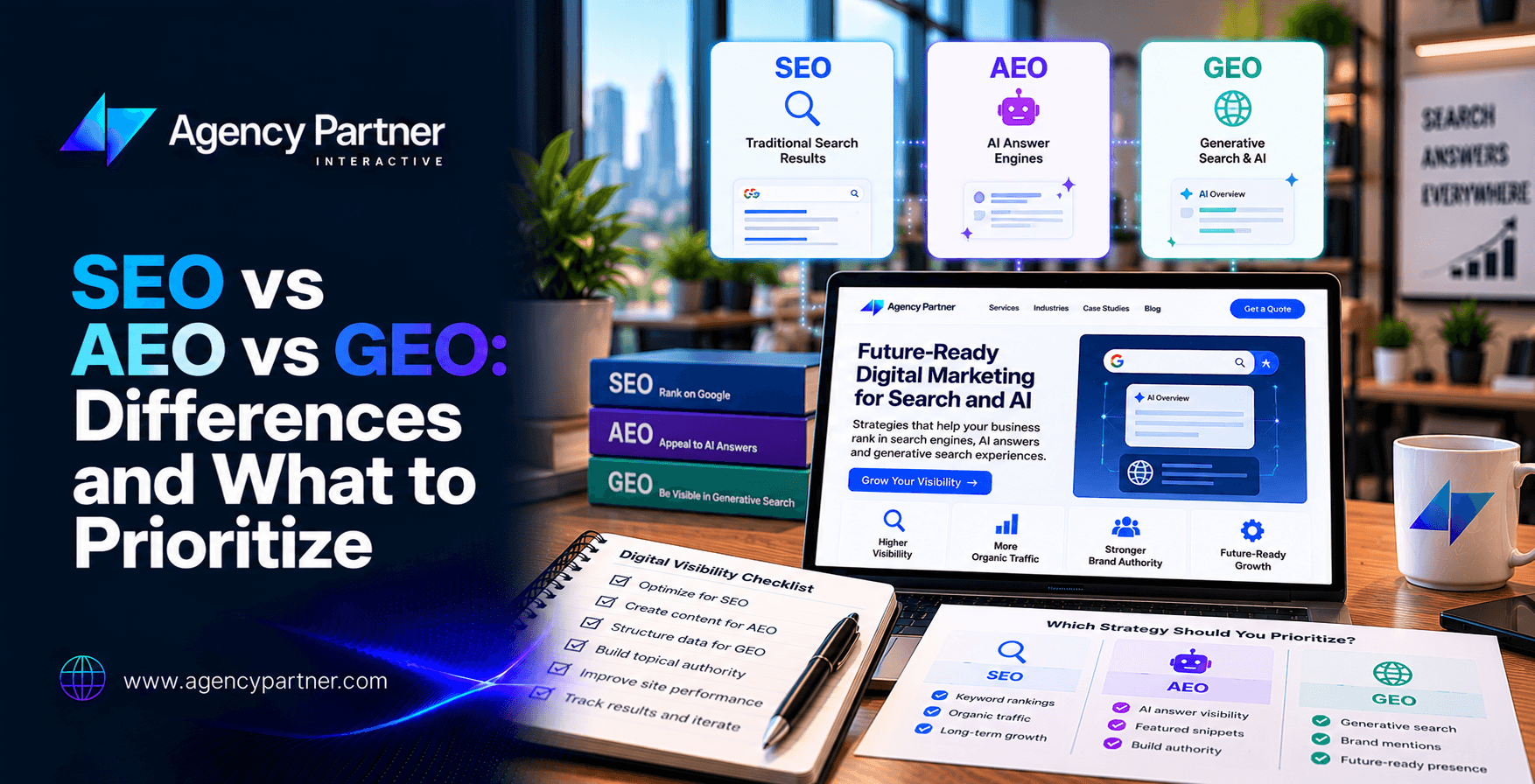
SEO, AEO and GEO describe related approaches to making information discoverable and useful. SEO addresses organic search visibility. AEO emphasizes answering questions clearly. GEO focuses on how a business and its content appear in generative search experiences.
These labels overlap, and practitioners do not always use them consistently. They are not three separate platforms or a requirement to build three versions of every page. This guide explains the distinctions, the shared work and how to choose priorities for your business.
SEO, AEO and GEO at a glance
| Approach | Main emphasis | Example outcome | What it does not guarantee |
|---|---|---|---|
| Search engine optimization (SEO) | Helping relevant public pages become discoverable and useful in organic search | A service page attracts qualified search visits. | A particular rank, traffic level or sales result |
| Answer engine optimization (AEO) | Providing clear responses to specific questions | A page supplies an answer shown in a search or assistant experience. | A featured snippet, voice response or answer placement |
| Generative engine optimization (GEO) | Improving the accuracy and visibility of content and brand representation in generated responses | An AI-generated comparison cites a relevant source page. | An AI mention, recommendation or citation |
A useful question-and-answer section can support all three. The distinction is the goal being evaluated, not a rigid boundary between different kinds of content.
What is SEO?
Search engine optimization helps search systems discover and understand relevant pages while improving the information and experience available to people. It includes technical access, page organization, content relevance and appropriate external signals.
For a business, the useful outcome is more than a keyword position. The page should reach a suitable audience and support a meaningful next step, such as an enquiry, purchase or informed decision.
Search engine optimization services can coordinate that work across the website. Specialist technical SEO services address access and implementation issues, while on-page SEO services focus on individual pages and their information.
What is AEO?
Answer engine optimization is a label used for making content useful when someone needs an explicit answer. That may involve a definition, explanation, comparison or short set of instructions, presented with enough context to be accurate.
AEO is not limited to voice search. A person typing a question can also receive a direct answer. Begin with the question and provide the relevant response before adding supporting detail.
Google’s featured snippet documentation explains that its systems select suitable pages; a publisher cannot simply mark a page as a featured snippet. Clear formatting helps readers, but it is not a placement instruction.
When considering answer engine optimization services, ask which questions are being addressed, why the existing pages are insufficient and how answer visibility will be measured.
What is GEO?
Generative engine optimization concerns visibility and accurate representation in systems that generate responses from available information. The work may examine whether the business is mentioned, which pages are cited and whether the generated description matches the facts.
GEO does not mean geography in this context. It should not be confused with location targeting or local SEO, although a location-based question can also produce a generated answer.
Generative engine optimization services should connect research, content improvement and measurement to defined business questions. Ask the provider to distinguish a brand mention from a source citation and a referral visit.
For a longer planning example, our B2B GEO planning guide explores the topic further. An implementation plan should still be evaluated against your audience and available evidence.
Does GEO replace SEO?
No. Search visibility and generated answers share important foundations, including accessible pages and useful information. A business should not abandon its working search programme because another label has become popular.
For Google’s AI Overviews and AI Mode, Google states that existing SEO practices remain relevant and that no separate special optimization or technical requirement is needed. Its AI features guidance is a better starting point than a promise of a secret AI markup format.
Other systems have their own access and retrieval behaviour. Treat platform differences as research questions rather than assuming one checklist controls every generated response.
What work supports all three?
Understand the customer’s real questions
Collect questions from search research, sales conversations and support requests. Separate someone learning a concept from someone comparing providers or checking a practical requirement.
Keyword research services can help map those needs to appropriate pages. Avoid creating several nearly identical articles for small wording variations when one clear page can answer the underlying question.
Make important information accessible
Review crawling controls, page access, internal navigation and whether the important content is actually available to the relevant system. Permission for search discovery is not necessarily the same setting as permission for model training.
For example, OpenAI’s crawler documentation distinguishes OAI-SearchBot for search from GPTBot for potential training use. Do not remove every AI-related restriction without understanding its purpose and your site’s policy.
Where implementation prevents access or reliable use, scope the required web development services. Our slow website diagnosis guide covers a separate performance investigation; a speed score alone does not establish whether a page will be cited.
Write answers that remain useful outside the introduction
Use descriptive headings and define unfamiliar terms. Explain conditions, exceptions and limitations close to the answer. Tables are useful for genuine comparisons, while a process is often clearer as a sequence.
A documented content strategy helps maintain page roles and review responsibilities. Content marketing services can support research, drafting and updates without producing duplicate pages for each optimization acronym.
Use evidence that can be checked
Identify the source and timeframe of numerical claims. Distinguish your own results from examples and industry estimates. Explain who contributed relevant expertise and update statements when the underlying information changes.
External coverage can provide useful context about a business, but it should not be manufactured as an AI citation tactic. Our off-page SEO guide introduces external visibility work. Relevance and accuracy matter more than collecting unrelated mentions.
Keep structured data aligned with the page
Use supported markup when it accurately describes visible information. Google’s structured data guidance explains its role in helping systems understand content and supporting eligible search features.
Markup is not a way to guarantee an answer, citation or recommendation. A visible FAQ may help readers even when it does not produce a special search display. Do not add claims or ratings to markup that the page cannot substantiate.
How should you measure SEO, AEO and GEO?
Use separate measures for separate questions. A report that combines rankings, mentions and revenue into one score can hide what changed.
| Measure | What it tells you | Limitation |
|---|---|---|
| Search impressions, clicks and relevant page performance | How public content performs in the available search reporting | It does not capture every generated answer or establish lead quality. |
| Observed answer placements | Whether a page appears for selected questions | Results vary by platform, time and context. |
| Brand mentions and linked citations | How a business or source is represented in sampled responses | A mention is not necessarily a citation or recommendation. |
| Identifiable referral visits | Recorded visits associated with a referring source | It does not measure every exposure or influence. |
| Qualified enquiries, purchases and other business outcomes | Whether recorded activity supports business goals | Attribution and incomplete tracking affect interpretation. |
Keep a repeatable question set and record the platform, date, context and observed sources. Repeated tests can reveal variability, but a small manual sample is not a complete market visibility estimate.
Google includes AI feature traffic within the overall Web search reporting described in its AI features documentation. Do not label all Search Console traffic as AI traffic or assume that every change has an AI-specific cause.
Choose tools after defining the measurement problem. Our startup SEO tool comparison covers budget and plan considerations. Buying a reporting subscription does not itself improve visibility.
What should your business prioritize first?
| Current situation | Useful first priority |
|---|---|
| Important pages are inaccessible or difficult to discover | Investigate technical access and internal navigation. |
| Pages attract visitors but leave buying questions unanswered | Improve the relevant information and customer journey. |
| Search performance is established but AI representation is unknown | Create a defined response sample and record mentions, citations and accuracy. |
| Generated descriptions contain incorrect business details | Correct the source information you control and document recurring errors. |
| Local customers cannot find clear location information | Improve genuine location details and applicable business listings. |
For businesses serving particular areas, local SEO services address a distinct location-related need. Our location page planning guide discusses supporting page content. Do not create duplicate city pages solely to add more keywords.
Agree which pages will change, who owns the work and how the result will be reviewed. You may need one coordinated plan with several measures, rather than three disconnected packages.
Frequently asked questions
Is AEO the same as GEO?
They overlap. AEO commonly emphasizes direct answers, while GEO emphasizes visibility and representation in generated responses. Providers may use either term more broadly, so compare the actual work and reporting.
Does GEO mean geographic SEO?
In this article, GEO means generative engine optimization. Local targeting is a different concept, although local questions can appear in generative search experiences.
Do I need an FAQ on every page?
No. Add a question section when it answers useful, unresolved questions. Avoid repeating information simply to create another format or inserting FAQs unrelated to the page’s purpose.
Can an agency guarantee AI citations?
No. An agency can improve source information, investigate access and measure selected outcomes. It cannot control every response generated by an external system.
How long should SEO, AEO or GEO take?
The answer depends on the starting problems, implementation scope and reporting window. Agree on milestones and review criteria rather than accepting a universal traffic or citation deadline.
Build one search visibility plan with clear responsibilities
Agency Partner Interactive helps businesses assess the technical, content and measurement work behind search visibility. Bring your priority pages, customer questions and current reporting to a search visibility planning discussion. Define what needs to improve before choosing the label for the work.