A human agent interaction costs between $6 and $8. An AI interaction costs $0.50. That gap is why 66% of customer service organizations now run at least one AI agent, up from 39% just one year ago. And 70% of those teams reported measurable value within 60 days of deployment.
But not all AI-powered customer service tools are the same. A customer service chatbot is not a voice AI. A voice AI is not an AI agent. Choosing the wrong one for the wrong job is how businesses end up with frustrated customers and wasted budgets.
This guide explains what each tool does, where it works best, and how to decide which one your business needs.
What Is Chatbot Service, and What Can It Actually Do?
What is chatbot service in plain terms? It’s software that responds to customer messages automatically, through your website, mobile app, or messaging platforms like WhatsApp or SMS.
Modern ai chatbot customer service tools use large language models (LLMs) to understand natural language. A customer doesn’t have to type an exact keyword. They can write “my order hasn’t shown up” and the chatbot understands the intent.
The best chatbots for customer service handle:
- FAQs: return policies, store hours, shipping timelines
- Order tracking and status updates
- Basic account management: password resets, profile updates
- Lead qualification: collecting contact details and routing to sales
- Chatbot self-service for common support tasks without any human involved
What a chatbot cannot do well: anything that requires judgment, accessing multiple systems, or taking action on behalf of the customer. That’s where AI agents take over.
What Is a Customer Support Chatbot for IT and Call Centers?
Not all chatbots serve external customers. Two high-value internal use cases are often overlooked.
Chatbot for IT Support
A chatbot for IT support handles the repetitive tier-1 helpdesk requests that slow down IT teams: password resets, software access requests, VPN troubleshooting, and hardware issue logging. IBM’s internal AI assistant “AskHR” automates more than 80 common HR processes using natural language. The same model works for IT.
When an employee types “I can’t log into Salesforce,” a well-built chatbot for IT support pulls up the relevant troubleshooting steps, escalates to a human if needed, and logs the ticket automatically, without the IT team touching it.
Chatbot for Call Center
A chatbot for call center deployments works differently than a web chat widget. In call centers, AI chatbots often function as pre-conversation tools, gathering account information, verifying identity, and categorizing the reason for the call before a human agent picks up.
This cuts average handle time by 30–40%. The agent starts with full context. The customer doesn’t repeat themselves. Everybody saves time.
Voice AI: The Fastest-Growing Tool in Customer Service
AI-powered customer service via voice has crossed from experiment to operational infrastructure.
Here’s what the numbers look like:
- Voice AI costs $1.18 per interaction vs. $7.40 for a human agent
- Companies using voice AI report 3-year ROI between 331% and 391%
- Average payback period: under six months
- AI voice agents reduce handle time by 35% and cut queue times by up to 50%
- 80% of businesses plan to integrate AI voice technology into customer service by 2026
Voice AI handles inbound calls the same way a chatbot handles text. A customer calls in. The voice agent answers immediately, no hold music, no queue. It asks questions, understands responses in natural language, and resolves the issue or routes to a human agent with full context already captured.
Where Does Voice AI Work Best?
- Call centers: The highest-volume, highest-cost customer service environment. A single AI voice agent can handle dozens of simultaneous calls. Human agents can’t.
- Healthcare: Appointment scheduling, prescription refill reminders, and FAQ handling. Medical practices automate 91% of standard reservation and appointment calls with voice AI.
- E-commerce: Order status, returns, and product questions. E-commerce returns hotline volume drops by 42% when AI handles first-tier calls.
- Real estate: Lead follow-up and property inquiry handling. Firms reduce missed lead opportunities by 70% after implementing AI voice agents.
Voice AI vs. Phone Chatbot: What’s the Difference?
A customer support bot on the phone that follows a rigid menu (“Press 1 for billing, Press 2 for technical support”) is not voice AI. That’s an IVR, interactive voice response. It’s rule-based and hated by customers. True voice AI understands natural speech. You say “I need to return something I ordered last week.” It understands, retrieves the order, and starts the return, without pressing anything.
AI Agents: When the AI Needs to Do the Work, Not Just Answer
- AI agents are the most powerful tier, and the most misunderstood.
- A customer support chatbot tells customers what to do. An AI agent does it for them.
- When a customer contacts your support team, the difference looks like this:
- Chatbot: “To return your order, visit our returns page and fill out the form.”
AI Agent: Looks up the order. Checks the return window. Initiates the return. Generates the shipping label. Sends the confirmation email. Updates your CRM. Done, in under two minutes, without a human involved.
Gartner predicts that agentic AI will autonomously resolve 80% of common customer service issues without human intervention by 2029. That’s not far away. And the businesses deploying agents now are already seeing the benefit.
Real numbers from real deployments:
- Klarna’s AI assistant handled the work of 700 full-time agents within one month of launch and projected a $40 million profit improvement in year one
- NIB Health Insurance saved $22 million and cut customer service costs by 60% with AI assistants.
- AI agents deliver an average $3.50 return for every $1 invested, with top performers achieving 8x ROI.
The Three-Tier Decision Framework
Here’s how to decide which tool your business needs.
| Tool | Best For | What It Can Do | What It Can’t Do |
| Customer service chatbot | Web, app, SMS support | Answer FAQs, guide users, collect info | Take action across systems |
| Voice AI | Phone support, call centers | Handle calls 24/7, route with context | Complex multi-step tasks |
| AI Agent | End-to-end resolution | Process returns, update records, act | Replace human judgment on exceptions |
Most businesses need more than one. Start with the highest-volume, lowest-complexity channel. Automate that first. Then expand.
How to Choose the Best AI Chatbot for Customer Service?
Not all ai chatbot solutions are equal. Here’s what separates a good implementation from a frustrating one.
- Define what “resolved” means before you build: A chatbot that answers a question is not the same as one that resolves an issue. Map your top 20 customer contact reasons. Identify which one’s end with an answer and which ones require an action. Design your solution accordingly.
- Don’t skip the escalation path: The fastest way to damage your brand with AI is to trap customers in an automated loop with no way out. Every ai chatbot for customer service needs a clear, easy escalation to a human, and when it escalates, it should pass full context, so the customer doesn’t repeat themselves.
- Train your actual data: Generic LLMs don’t know your return policy, your product catalog, or your customer base. The best AI chatbot solutions are trained on your specific knowledge base. The more specific the training, the higher the resolution rate.
- Measure resolution rate, not just deflection: Chatbot self-service success is measured by how many issues the AI fully resolves, not just how many issues it deflects before a human pick up. Track resolution rates from day one. Optimize toward it.
- Pick the right platform for your stack: For web and app: Intercom Fin, Drift, Tidio Lyro. For call centers: Five9, Genesys, NICE inContact with AI. For enterprise: Salesforce Einstein, IBM watsonx. For artificial solutions, chatbot needs legacy systems: custom API integration is often the right path.
The Bottom Line
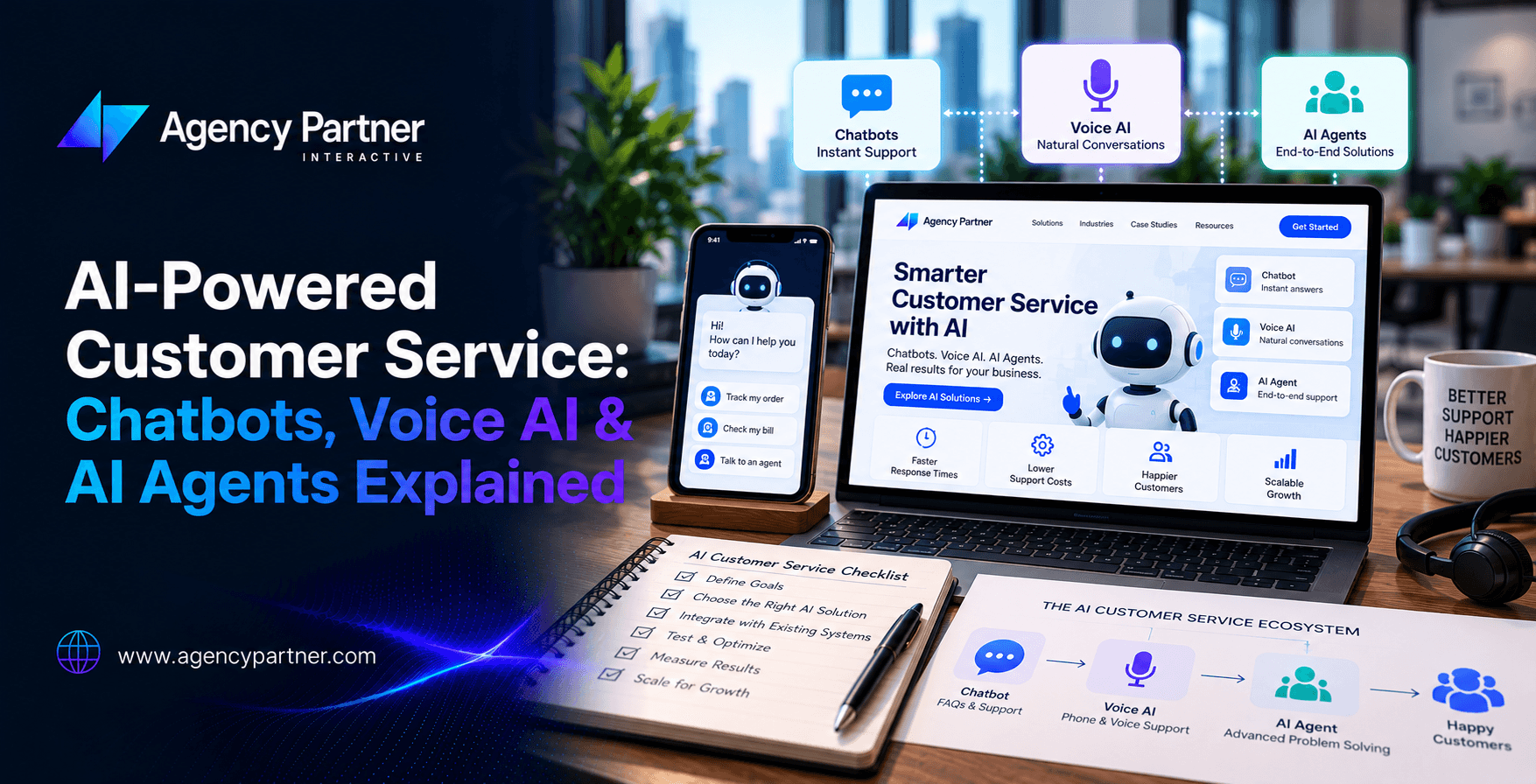
AI-powered customer service is not a single product. It’s a layered system, chatbots for high-volume text inquiries, voice AI for phone and call center operations, and AI agents for end-to-end resolution of complex cases.
The market for these tools is projected to reach $15.12 billion in 2026, growing at 25.8% annually. Conversational AI alone is projected to cut $80 billion in contact center labor costs this year.
The businesses winning in customer service right now aren’t those with the most agents. They’re the ones that figured out which conversations AI handles better, faster, cheaper, and more consistently, and built the right layer for each one.
Agency Partner Interactive helps businesses design and deploy AI customer service solutions that fit their workflows, their customers, and their growth goals. Whether you need a focused customer support chatbot, a voice AI for your call center, or a fully agentic support system, we build it to work from day one. Talk to our team.
FAQs
-
What is an AI-powered customer service chatbot?
It’s software that uses artificial intelligence to respond to customer inquiries automatically, through websites, apps, or messaging platforms, without requiring a human agent for every interaction.
-
What is the difference between a chatbot and an AI agent?
A chatbot answers questions and guides users. An AI agent takes action, processing returns, updating accounts, and completing tasks across multiple systems without human involvement.
-
How much does AI customer service cost compared to human agents?
AI interactions average $0.50, compared to $6–$8 for a human agent. At scale, that difference compounds significantly.
-
What is the best AI chatbot for customer service?
It depends on your channel and uses the case. Intercom Fin and Tidio Lyro lead for web. Five9 and Genesys lead for call centers. Enterprise teams often use Salesforce Einstein or IBM watsonx.
-
What is chatbot self-service?
Chatbot self-service lets customers resolve issues on their own, checking orders, processing returns, updating account details, without waiting for a human agent. The AI handles the full interaction from end to end.
-
Is voice AI different from a traditional phone menu (IVR)?
Yes. A traditional IVR is rule-based, it follows a script and requires button presses. Voice AI understands natural speech and responds conversationally, resolving issues without rigid menus.