The most honest answer to this question: it depends. But “it depends” isn’t useful if you’re trying to plan a budget.
So, here’s a better answer. According to Clutch’s 2026 pricing data, the average custom software project costs $132,480 and takes 13 months to deliver. Most small- and medium-sized projects fall between $30,000 and $100,000, according to GoodFirms’ 2026 research across 100+ software companies.
That’s a wide range. Your job — before talking to any custom software development company, is figuring out where your project falls. This guide walks you through how to do that.
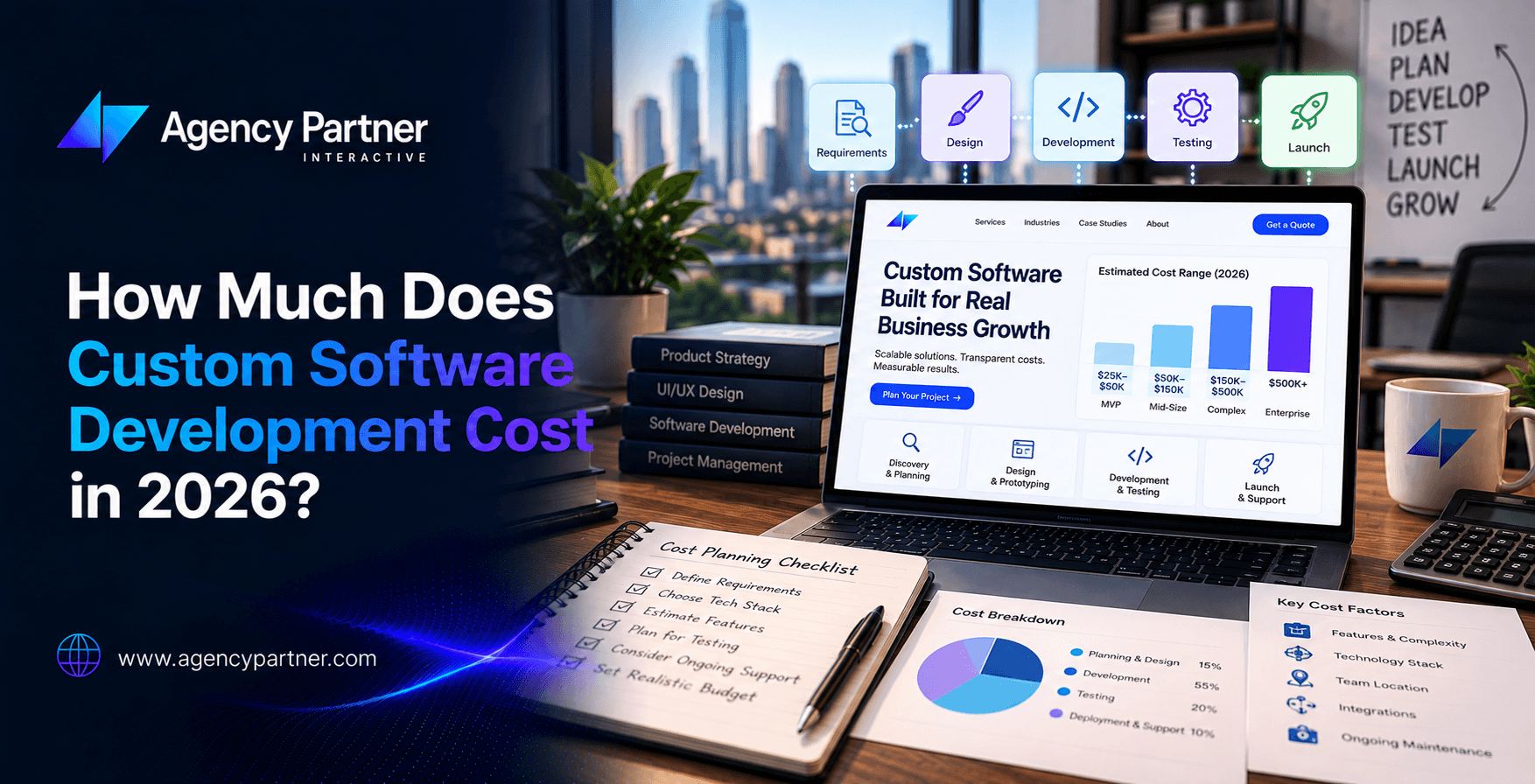
Custom Software Development Cost at a Glance
Before we get into the details, here’s the 2026 pricing landscape in one table:
| Project Type | Cost Range | Timeline |
| Simple MVP / internal tool | $25,000 – $75,000 | 2–4 months |
| Small business application | $75,000 – $150,000 | 4–6 months |
| Mid-market business software | $150,000 – $300,000 | 6–10 months |
| Enterprise platform | $300,000 – $500,000+ | 10–18+ months |
These are starting points, not quotes. Your final number depends on the seven factors below.
Why Custom Build Software Costs What It Does
When you pay for custom software development, you’re not buying a product off a shelf. You’re paying a team of people, designers, developers, project managers, QA testers, to build something that doesn’t exist yet. That takes time. And time costs money.
The size of that team, how long they work, and where they’re located are the three levers that move your final number the most.
7 Factors That Determine Your Custom Software Development Cost
1. Scope and Size
Bigger software costs more. Simple but true. Small apps have 10–25 pages or screens. Medium apps have 25–40. Large apps exceed 40. Every unique screen, every button that opens something new, adds to the count.
Before you talk to any developer, try to list every screen your software needs. You’ll be surprised how fast the list grows. And every item on that list has a price tag.
2. Complexity
Not all screens are equal. A dashboard that displays live data costs more than a static information page. A system that runs calculations, applies logic, and handles multiple user roles costs more than a simple form.
Ask yourself: does my software need to think, or does it just need to display? The more logic baked in, the higher the cost to develop.
3. Integrations
Does your custom build software need to connect to anything else? Payment processors, CRMs, ERPs, shipping APIs, or third-party databases all add cost. Easy integrations (PayPal, Stripe, Twilio) add a few thousand dollars. Complex or custom integrations with legacy systems can add $20,000–$50,000 or more, because nobody knows what’s on the other side until the work starts.
4. Design
Design isn’t decoration. It’s a function. And it’s a cost. Expect design to represent 15–25% of your total project budget. For a $100,000 project, that’s $15,000–$25,000 just for UI/UX. Custom illustrations, animations, and brand-aligned interfaces push that number higher. A basic, clean design keeps it lower.
5. Data Migration
Do you have existing data that needs to move into the new system? Customer records, order history, product catalogs, any of it? Data migration requires custom scripts. Those scripts take time to write, test, and run. Budget for it separately. Most teams underestimate this cost until they’re already in the project.
6. Who Builds It
This is the biggest cost variable of all. According to GoodFirms’ 2026 survey, 56.3% of software companies globally offer development at $20–$50/hour, most of which are in Southeast Asia, Eastern Europe, and Latin America.
US-based developers charge $100–$200+ per hour. Offshore teams charge $20–$80 per hour. The hourly rate difference is real. But so is the difference in communication, accountability, and project management overhead.
For most US businesses developing custom software, working with a US-based or nearshore team produces fewer surprises, even if the hourly rate is higher. The cost of miscommunication and rework often exceeds the savings from a lower rate.
7. AI-Assisted Development
In 2026, most quality development teams use AI tools to write and test code faster. This is a good thing for your budget.
AI-assisted workflows can reduce development effort by roughly 20–30% compared to traditional approaches for repetitive tasks like standard integrations and testing support. Complex architecture and business logic still require experienced engineers, AI doesn’t change that. But for the right parts of your project, AI acceleration is real and it should reduce your quote compared to two years ago.
Ask any custom software development company you evaluate whether they use AI-assisted development tools. If they don’t, they may be slower and more expensive than their competitors.
Custom Software vs. Off-the-Shelf: When Does Custom Win?
Off-the-shelf software is cheaper upfront. Always. A SaaS subscription might cost $50–$500 per month. Custom software costs $50,000–$300,000+ to build. So why does anyone choose custom?
Two reasons:
- Off-the-shelf doesn’t fit. Your process has nuances that no existing tool handles well. You spend more time working around the software than using it.
- Long-term cost. Per-user SaaS fees compound. A team of 50 paying $100/user/month is $60,000/year, every year. Custom software annual maintenance typically runs 15–25% of development cost. Off-the-shelf software runs $5,000 to $50,000+ in recurring license fees with no end date.
Run the math on a 5-year horizon. For many mid-sized businesses, custom becomes the cheaper option by year three.
Custom Software Development for Small Business: What to Expect
Custom software development for small business is increasingly accessible. You don’t need a $500,000 budget to get something built. The average cost of custom software for small business in 2026 typically falls between $30,000 and $150,000 depending on scope.</cite)
The entry point is a focused MVP, a version of your software that solves one specific problem well. No extras. No features you might use someday. Just the core workflow, built clean.
What that $30,000–$75,000 MVP looks like:
- One user role (or two, simply defined)
- 10–20 screens
- One or two integrations
- Basic reporting
- No custom animations or complex design
It won’t do everything. But it will do the one thing you need it to do, better than any spreadsheet or off-the-shelf tool is doing it right now. After launch, you add features. One sprint at a time. This approach is how small businesses avoid going over budget and ending up with software they never fully use.
The Hidden Costs Nobody Mentions Upfront
This is where most budgets go wrong. Discovery and Planning Before writing a line of code, a good team will spend time defining your requirements, mapping your workflows, and designing the architecture. Discovery and business analysis costs $5,000–$15,000 for smaller projects and $15,000–$40,000+ for large ones. Some companies include this in their development quote. Others charge separately. Ask upfront.
Post-Launch Maintenance Software needs ongoing support. Bugs surface after launch. Browsers update and break things. Integrations change their APIs. Plan to spend 15–25% of your build cost annually on maintenance, indefinitely.
Hosting and Infrastructure Cloud hosting isn’t free. A modest application might run $200–$500/month on AWS or Azure. High-traffic platforms can run $2,000–$10,000/month or more.
Training and Onboarding Your team needs to learn the new system. Budget time and potentially budget for documentation or training sessions. Add these up before you finalize your total budget. The build is often not the most expensive part over a five-year window.
How to Get an Accurate Estimate
No custom software development company can give you a real number from a two-line description. The more specific you are, the more accurate your estimate will be.
Before reaching out, prepare:
- A list of the problems your software needs to solve, not features, problems
- A list of every user type who will use it and what they need to do
- A list of existing tools it needs to connect to
- An idea of your data, what’s moving over, how much, from where
- A rough idea of your budget, even a range helps a development team scope appropriately
If you’re not sure where to start, a discovery session with a qualified team is worth the investment. It turns your idea into a scope, and a scope into a real quote.
Agency Partner Interactive works with businesses across industries to scope, build, and launch custom software solutions. Whether you’re a small business looking for your first internal tool or a scaling company that’s outgrown on your current systems, our team builds software that fits your workflow, not the other way around. Talk to our team today.
FAQs
-
How much does custom software development cost in 2026?
Most projects fall between $30,000 and $300,000. The average project costs $132,480 and takes 13 months. Enterprise platforms can exceed $500,000.
-
How much does custom software development cost for a small business?
Small business custom software typically costs $30,000–$150,000, depending on the number of screens, integrations, and user roles involved.
-
How long does developing custom software take?
A simple MVP takes 2–4 months. Mid-size business applications take 4–8 months. Enterprise platforms take 10–18 months or longer.
-
Is custom software more expensive than off-the-shelf?
Upfront, yes. But SaaS fees compound annually. Over 3–5 years, custom software is often cheaper, especially for growing teams with per-user pricing.
-
What does it cost to maintain custom software after launch?
Plan for 15–25% of your original development cost per year in maintenance, hosting, and ongoing improvements.
-
How do I find a custom software development company near me?
Search for firms with verified client reviews on Clutch or G2, a portfolio of completed projects, and US-based or nearshore teams. Local teams offer easier communication and on-site collaboration when needed.