Key Takeaways: The global LMS market is valued at $31.6–$35.23 billion in 2026, projected to hit $88–$122 billion by 2032. 77% of U.S. organizations rely on eLearning for professional development. Custom lms development delivers workflows, integrations, and learner experiences that off-the-shelf platforms can’t match. 72% of businesses say LMS technology gives them a measurable competitive advantage in workforce efficiency.
Off-the-shelf LMS platforms serve a purpose until they don’t. Once your organization outgrows the default course structure, hits integration limits, or needs workflows that don’t fit the vendor’s template, the limitations become costly. Workarounds accumulate. Licenses scale with users while features don’t. The platform shapes your training strategy instead of the other way around.
That’s the inflection point where custom lms development becomes the smarter investment. A custom learning management system built around your specific workflows, user roles, content types, and compliance requirements delivers what no packaged tool can: a platform that fits your organization exactly, and scales as you grow.
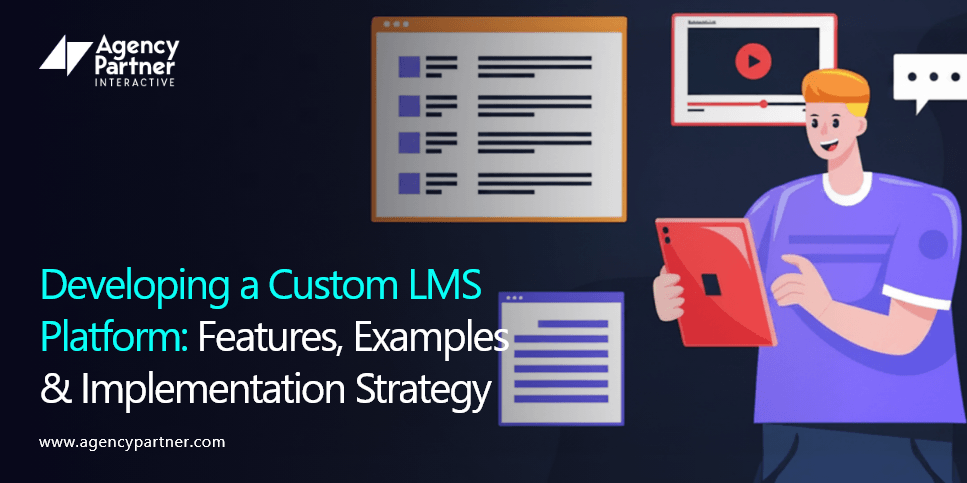
This guide covers everything decision-makers need to know: why custom lms software development outperforms off-the-shelf in the right context, what features define a strong custom elearning platform, how custom learning management system development works end to end, and what to look for in an lms development company. With dozens of lms development companies competing for your budget in 2026, knowing how to evaluate lms development services before signing a contract is just as important as knowing what to build.
Why Is Custom LMS Development Growing So Fast in 2026?
The numbers explain the shift. The global eLearning market is projected to exceed $375 billion by 2026. Corporate eLearning alone is set to reach $462.6 billion by 2027. LMS platforms account for 89% of all learning technology in use globally, ahead of every other EdTech category.
But here’s what drives organizations toward custom learning management system development specifically: 42% of companies are currently upgrading or replacing their existing LMS. Most of those replacements are triggered by the same issues, rigid feature sets, poor integration with existing systems, inability to scale, and learner experiences that don’t match modern expectations. When organizations evaluate their options, custom learning management system development consistently wins on long-term TCO and workflow fit, even if the upfront cost of custom elearning software is higher than a SaaS subscription.
Custom lms software development addresses each of these gaps directly. Rather than fitting your training program into a vendor’s architecture, lms software development builds the architecture around your program, and qualified lms development services make that process far less daunting than most organizations expect.
Custom LMS vs. Off-the-Shelf: What’s the Real Difference?
Before committing to custom elearning software, it’s worth understanding where each option wins.
| Custom LMS | Off-the-Shelf LMS | |
|---|---|---|
| Fit | Built to your exact workflows | You adapt to the platform |
| Integrations | Native, deep, custom-built | Limited to vendor connectors |
| Scalability | Scales without per-user cost jumps | Licensing costs increase with users |
| Branding | Fully white-labeled | Limited or template-based |
| Compliance | Built to your regulatory environment | Generic compliance modules |
| Timeline | 3–9 months to build | Days to deploy |
| Cost | Higher upfront, lower long-term TCO | Lower upfront, higher long-term |
The break-even point for custom lms development typically arrives between 18 and 36 months, after which the TCO advantage over per-seat SaaS licenses compounds annually.
What Features Should a Custom Learning Management System Include?
The right custom elearning platform is defined by the features it’s built around. Here are the core modules every credible lms software development engagement should deliver:
1. Role-Based User Management
A custom learning management system must support granular user roles, administrators, instructors, learners, managers, and external partners, each with tailored dashboards, permissions, and content access. This is one of the most critical differentiators between custom lms software development and generic platforms, where role flexibility is often an afterthought.
2. Course Builder and Content Management
The heart of any custom elearning platform is its content authoring experience. Custom lms software solutions support SCORM, xAPI, AICC, and CMI5 content standards, ensuring compatibility with any third-party content library or internally produced training material. Drag-and-drop course builders, video hosting, assessment tools, and branching scenarios are standard in modern custom elearning software.
3. AI-Powered Personalization
In 2026, AI integration is a defining lms software development priority. AI-powered recommendation engines analyze learner behavior and performance data to surface the next most relevant course automatically. AI-powered LMS systems can improve recommendation relevance by up to 50%, one of the clearest ROI arguments for custom learning management system development over static off-the-shelf catalogs.
4. Advanced Analytics and Reporting
A purpose-built custom elearning platform captures every learner interaction, completion rates, assessment scores, time-on-task, drop-off points, and certification status, and surfaces it through dashboards tailored to each role. HR wants workforce-wide skill gap analysis. Compliance teams want certification audit trails. Managers want team progress views. Off-the-shelf lms software solutions rarely deliver all three simultaneously.
5. Mobile-First Design
54% of LMS users access learning content via mobile devices. Any custom learning management system that isn’t built mobile-first in 2026 is already behind. Responsive design, offline content access, push notifications, and native app deployment should be standard deliverables in every custom lms software development engagement.
6. Gamification
Gamified training yields 43% higher engagement and 15–20% better knowledge retention than traditional formats. Points, badges, leaderboards, and progress streaks built natively into a custom elearning software environment outperform bolt-on gamification tools added to rigid SaaS platforms. 83% of learners report feeling more motivated in gamified learning environments.
7. Compliance and Certification Management
For regulated industries, healthcare, finance, manufacturing, energy, compliance training is the primary driver of custom lms development investment. Regulated industries spend approximately 50% more on LMS than non-regulated sectors. A custom learning management system built for compliance includes automated certification tracking, renewal reminders, audit logs, and regulatory reporting, features that generic lms software solutions address only partially. This is exactly where custom elearning software built by experienced lms development companies consistently outperforms off-the-shelf lms software solutions.
8. Third-Party Integrations
The most valuable lms software solutions don’t operate in isolation. Custom lms development services should deliver native integrations with your HRIS (Workday, BambooHR), CRM (Salesforce, HubSpot), video conferencing (Zoom, Teams), SSO providers, and content libraries, through purpose-built APIs rather than generic middleware connections.
9. White-Label Branding
For organizations deploying training to external audiences, customers, partners, franchisees, full white-label capability is essential. A custom elearning platform with white-label support presents a seamless brand experience with no third-party vendor identity visible.
10. Multi-Tenancy
Enterprises managing training across multiple business units, regions, or client organizations need multi-tenant architecture. This allows one custom learning management system to serve multiple distinct audiences with separate content libraries, user bases, analytics, and branding, from a single backend instance.
Real-World Examples of Custom LMS Platforms in Action
Understanding what custom lms software development looks like in practice helps frame the investment decision:
Corporate Compliance Training (Financial Services)
A regional bank with 4,000 employees needed mandatory compliance certifications tracked, renewed, and audit-ready at any time. Off-the-shelf lms software solutions couldn’t integrate with their existing HR system or generate the specific audit reports required by regulators. A custom elearning platform built by an experienced lms development company delivered HRIS integration, automated renewal workflows, and real-time compliance dashboards, reducing audit preparation time by 60%.
Partner Enablement (SaaS Company)
A B2B SaaS company needed to train reseller partners across 12 countries in six languages. A custom learning management system with multi-tenancy, localization, and Salesforce CRM integration allowed the company to track partner certification alongside deal performance, directly linking training completion to revenue outcomes.
Customer Education (E-Commerce Platform)
An e-commerce platform used custom elearning software to build a customer academy, reducing support ticket volume by 35% by turning product documentation into structured, gamified learning paths available 24/7.
How Does Custom LMS Development Work? The Implementation Strategy
Every credible lms development company follows a structured process. Here’s how custom learning management system development works end to end:
Phase 1: Discovery (2–4 weeks)
The lms development company maps your training workflows, learner personas, content types, compliance requirements, and integration landscape. This phase defines the feature scope, technology stack, and architecture, and is where most failed lms software development projects went wrong by skipping it. Reputable lms development companies make discovery non-negotiable, regardless of project size.
Phase 2: Architecture and UX
Design (3–6 weeks) Custom lms software development requires learner-centric UX design from the start. Role-based interface wireframes, information architecture, and accessibility standards (WCAG 2.1 AA) are validated with real users before development begins. Good lms development services invest heavily here, because poor UX is the leading reason learners abandon courses. Any lms development company that skips structured UX validation at this phase is cutting a corner that will cost significantly more to fix post-launch.
Phase 3: Development (8–20 weeks)
The core lms software development phase. Backend infrastructure, frontend interfaces, content management tools, and integrations are built in parallel sprints. Strong lms development services use agile methodology with two-week sprint reviews, keeping stakeholders aligned without surprises at go-live. Custom elearning software built this way stays on scope and budget far more reliably than waterfall approaches.
Phase 4: QA, Compliance Testing, and UAT (3–4 weeks)
Every custom elearning software build must pass SCORM/xAPI compliance testing, security audits, load testing, and user acceptance testing with real learners. This phase separates credible lms development companies from those who push to go-live before the platform is ready. The best lms development companies treat UAT as a collaboration, not a formality.
Phase 5: Launch and Post-Launch Support
Deployment, data migration, staff training, and a defined support SLA. The best lms development company partners provide 90-day hypercare support post-launch, ensuring adoption issues are resolved before they become institutional resistance. Ongoing lms development services agreements also allow for feature iteration as learner needs evolve.
How Much Does Custom LMS Development Cost?
Custom lms development cost depends on complexity, feature scope, and integration requirements:
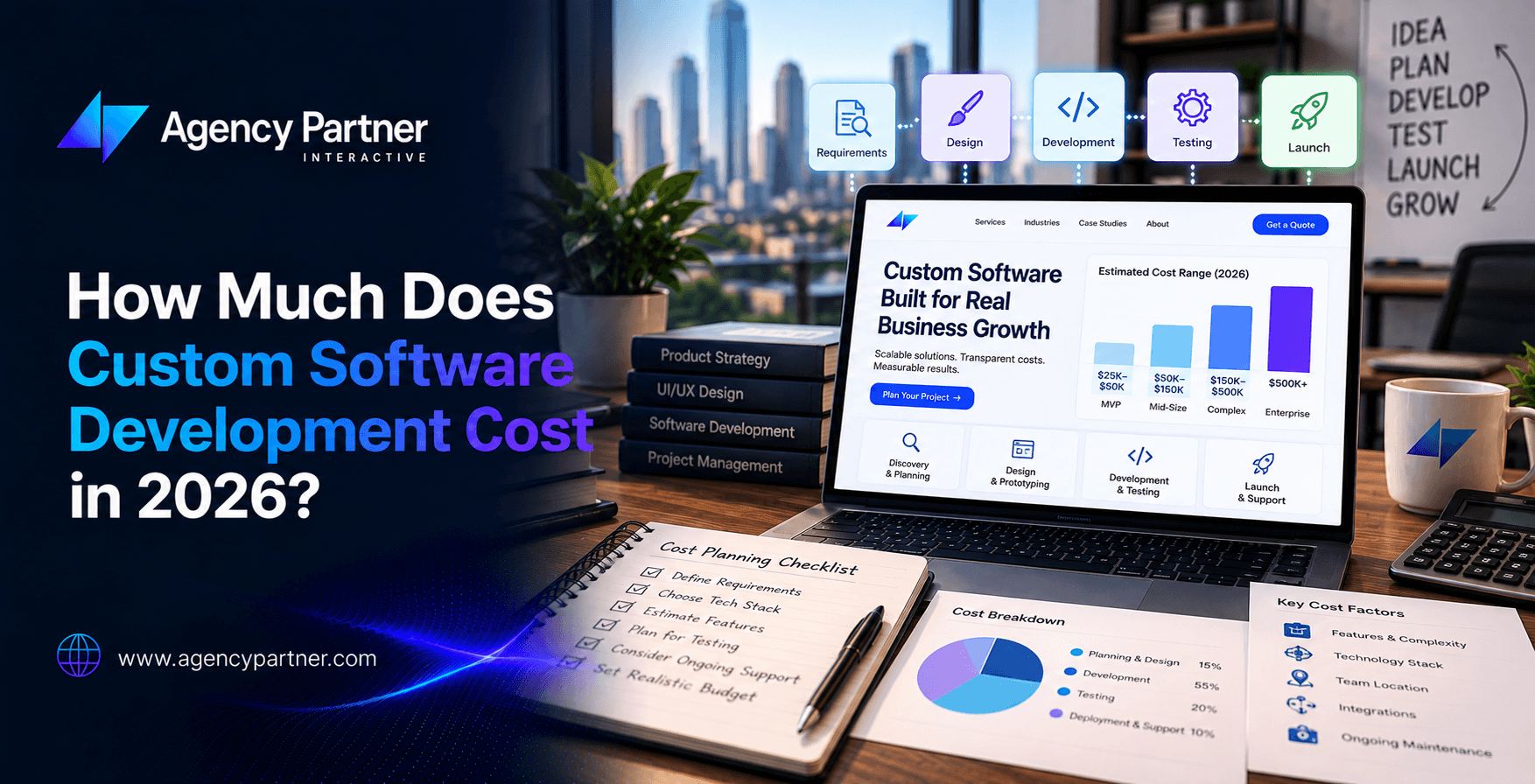
- MVP / Basic custom elearning platform: $40,000–$80,000
- Mid-complexity custom LMS (with integrations, mobile, analytics): $80,000–$200,000
- Enterprise custom learning management system (multi-tenant, AI, full compliance): $200,000–$500,000+
Ongoing lms development services for maintenance, new feature development, and infrastructure management typically run 15–20% of initial build cost annually.
The ROI case is well-documented. IBM found that every $1 invested in online employee training returns $30 in productivity. Organizations using custom elearning software for compliance training reduce error-related costs, which average $62,000 per incident in high-risk industries.
What Should You Look for in an LMS Development Company?
Choosing the right lms development company is as important as the platform architecture itself. Evaluate lms development companies on:
- Demonstrated experience delivering custom lms software development in your industry vertical
- Portfolio of live custom elearning platform deployments with documented outcomes
- In-house UX, backend, and QA capability, not outsourced to unnamed subcontractors
- SCORM, xAPI, and accessibility standards expertise
- Clear post-launch lms development services support terms and SLA commitments
- Transparent pricing with no hidden custom learning management system development fees
The best lms development companies in 2026 bring both EdTech domain knowledge and enterprise software engineering depth. Those two capabilities together define whether a custom learning management system actually gets adopted after launch. Ask any lms development company shortlist candidates to show you live lms software solutions they’ve built, not mockups, not demos, and speak directly to the clients who use them.
Custom learning management system development is a long-term infrastructure decision. The right lms development companies treat it that way, and so should you. Strong lms software solutions built on a solid custom learning management system development foundation pay dividends for five to ten years.
FAQs
1. What is custom LMS development?
Building a learning management system tailored to your workflows, integrations, and learner needs, instead of adapting to off-the-shelf software.
2. How long does custom LMS software development take?
Typically 3–9 months depending on feature complexity, integration requirements, and team size.
3. What is the cost of custom learning management system development?
From $40,000 for an MVP to $500,000+ for enterprise platforms with AI, multi-tenancy, and compliance modules.
4. When should I choose custom LMS over off-the-shelf?
When off-the-shelf limits your workflows, integration needs are complex, or long-term per-seat licensing costs exceed custom build TCO.
5. What makes a good LMS development company?
Healthcare or industry-specific domain knowledge, proven platform portfolio, in-house QA, and clear post-launch support terms.
References
- Research.com — 40 LMS & eLearning Statistics 2026 — research.com/education/lms-elearning-statistics ($375B eLearning market; 77% U.S. org adoption; IBM $30 ROI per $1 training investment)
- Atrixware — 100+ LMS Statistics 2026 — atrixware.com/blog/wp/over-100-lms-statistics-for-2025 (72% competitive advantage; 42% upgrading LMS; 43% gamification engagement lift; 50% AI accuracy improvement)
- ProProfs Training — 30+ eLearning Statistics 2026 — proprofstraining.com/blog/elearning-statistics (LMS market $31.6B–$35.23B in 2026; $88–$122B by 2032; 89% LMS tech adoption)
- iSpring — eLearning Statistics 2026 — ispringsolutions.com/blog/elearning-statistics (54% mobile LMS usage; 75% cloud LMS deployments; corporate 58% of global eLearning)
- Eskilled — 50 LMS Statistics 2026 — lms.eskilled.com.au/blog/lms-statistics-reveal-future-of-learning (70% cloud deployment share; 42% replacing LMS; Canvas 35% North America share)