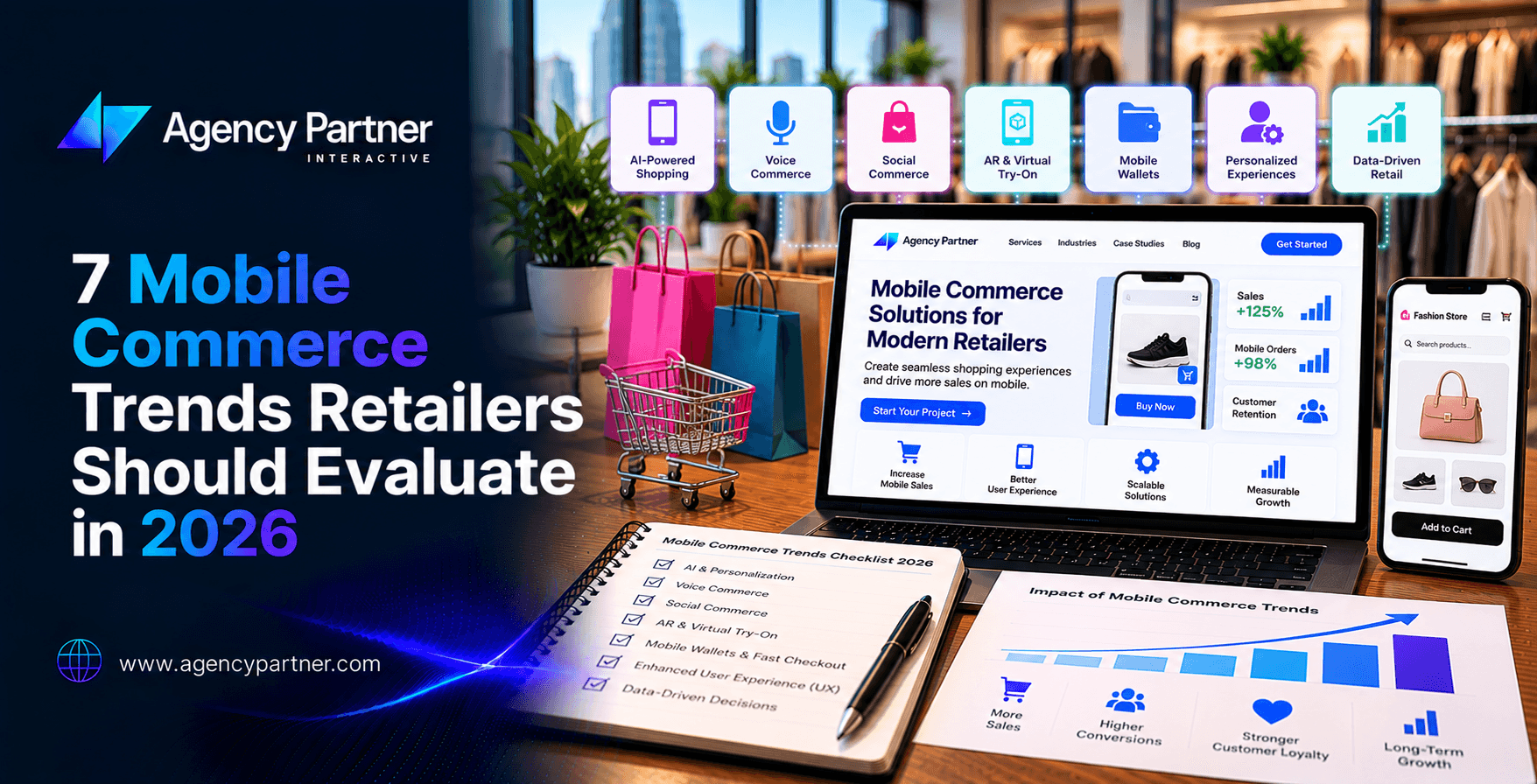
A customer checks an item’s availability while standing near your store. Another finds a demonstration on social media and opens the product page on a phone. A returning buyer wants to complete an order without entering the same details again. Mobile commerce has to support each of these situations.
The mobile commerce trends worth evaluating in 2026 connect discovery, payment, fulfilment and repeat use. Some involve newer tools, while others are established capabilities that still need careful implementation. Their usefulness depends on the customers you serve and the buying problems you can identify.
This guide covers seven practical priorities, what to check before investing and how to judge whether a change helps. It does not assume that every retailer needs a new app, an AI assistant or a complete platform replacement.
What is mobile commerce?
Mobile commerce means carrying out commercial activities through mobile devices. For retailers, that includes discovering products, comparing options, purchasing, arranging collection and managing orders through mobile websites or applications.
Mobile ecommerce trends should therefore be evaluated across the whole journey, including the handoff between online information and the physical store. A fast payment flow cannot make up for incorrect stock information or unclear collection instructions.
1. Accelerated checkout reduces repeat data entry
Entering an address and payment information on a small screen can interrupt a purchase. Supported accelerated checkout methods can reuse details available to the customer and reduce some of that repeated work.
Shopify’s accelerated checkout documentation explains how supported methods can speed up returning customers’ payments. Availability and presentation depend on the store configuration and payment method; do not assume every customer sees the same options.
Test the complete order, including discounts, shipping, collection and failure messages. Faster payment is useful when the customer still understands the total and receives a reliable confirmation.
Our mobile checkout testing guide covers the shopping checks. For implementation, compare the scope of Shopify development services or WooCommerce development services with the capabilities already available on your platform.
Evaluate: successful checkout completion, payment failures and customer questions about the final order.
2. Mobile performance includes responsiveness and stability
A page can display quickly but remain difficult to use. A button may respond late, a product image may shift the layout or a promotional overlay may block the next action.
Google’s Core Web Vitals guidance covers loading, interactivity and visual stability. Use performance evidence from important customer journeys and representative devices. A single desktop test is not a complete picture of the mobile store.
Investigate scripts, product media and app widgets that interfere with use. Combine UI/UX design services with targeted web development services when the problem involves both interface behaviour and implementation.
Our guide to ecommerce page performance explains the business context. Better technical measurements should still be evaluated alongside actual shopping outcomes.
Evaluate: task completion, interaction delays, checkout errors and performance across commonly used devices.
3. Local product information connects mobile browsing with store visits
A shopper looking for a nearby product needs accurate availability, location and collection information. These details are particularly important when the person intends to visit a store rather than wait for delivery.
For eligible merchants, Google’s free local listings can surface local product availability. Paid local inventory ads are a separate option. Both depend on maintaining suitable inventory information.
Confirm which system controls stock and how quickly changes reach customer-facing pages. Explain collection timing and what happens if an order cannot be fulfilled. Do not display a promise the store team cannot honor.
Ecommerce website development services can help address the storefront and integration requirements. Plan the customer communication and staff workflow as part of the same change.
Evaluate: stock-related cancellations, collection exceptions and verified orders. Requests for directions are useful interactions, but they are not confirmed sales.
4. Social product discovery needs a dependable mobile destination
Product demonstrations and customer questions can create a useful bridge from social content to shopping. The opportunity is strongest when the content explains the item and the destination continues the same offer.
Check the product link, variant availability, price, delivery information and landing page inside the relevant mobile browsing experience. An advert or creator video can generate attention while the store loses the purchase at the next step.
Where a platform offers native shopping features, verify current market and account eligibility. Do not base the plan on an old assumption that every network supports the same checkout or product-tagging experience.
Ecommerce social media marketing services should connect content and distribution with a measurable shopping journey. Our retail digital marketing guide explains how to compare that channel with other acquisition options.
Evaluate: suitable product visits, landing-page problems, completed orders and acquisition costs, alongside engagement.
5. AI-assisted shopping depends on reliable product information
AI tools can help customers ask product questions or narrow a catalogue. They become less useful when descriptions are inconsistent, specifications are missing or the assistant cannot distinguish available products from unavailable ones.
Begin with accurate product information and clear answers to recurring buying questions. If implementing AI chatbot development services, define reliable information sources, permitted actions and an escalation route. The assistant should not invent compatibility, delivery dates or refund promises.
For discovery through Google’s AI search features, existing SEO practices remain relevant. Google’s AI features guidance does not require a separate special optimization or guarantee that a page will be included.
Ecommerce SEO services can address the public catalogue’s search foundations. Our AI ecommerce overview discusses the broader topic; assess each application against a concrete customer need.
Evaluate: answer accuracy, unresolved questions, appropriate escalations and purchases supported by the interaction.
6. Retail apps need a reason for customers to return
A branded app can support useful repeat tasks, such as replenishment orders, loyalty access or managing collection. Installing an app is an extra step, so the benefit should be clear before you invest in promoting it.
Review customer buying frequency, the task the app improves and the resources needed to operate another channel. Our guide to deciding whether an ecommerce mobile app is worthwhile covers that investment question.
When the case is credible, compare ecommerce app development services against the required store integrations and first useful customer journey. The ecommerce app development process guide provides implementation detail.
Evaluate: adoption, meaningful return use and total customer value across channels. Moving existing website orders into an app does not automatically create additional revenue.
7. Retention messages need relevance and customer control
A mobile customer may receive email, SMS, app notifications and in-account messages from the same retailer. Repeating every promotion across all channels can create noise rather than a useful relationship.
Define which messages are transactional, which are promotional and which preferences apply to each route. Respect permissions and opt-outs. Notification availability varies with the device, browser, application and user choices, so avoid assuming every customer is reachable through the same method.
Use ecommerce email marketing services to organize relevant follow-up alongside the rest of your communication plan. A care message after delivery or a suitable restock notice can be more useful than another general discount.
Evaluate: repeat purchases and useful customer actions together with complaints, unsubscribes and message fatigue.
Which mobile commerce trend should you prioritize?
Choose from evidence about the shopping journey, not from the novelty of the feature. A store with payment failures should usually investigate checkout before commissioning an AI shopping assistant.
| What you observe | Priority to investigate | Useful check |
|---|---|---|
| Customers struggle to complete purchases | Checkout and payment configuration | Test real order scenarios and failure states. |
| Pages or controls behave poorly on phones | Performance and mobile usability | Compare representative devices and actual tasks. |
| Local shoppers receive incorrect availability | Inventory and fulfilment information | Trace updates from the source system to the customer. |
| Social visits rarely reach suitable products | Content-to-product handoff | Test the offer and destination together. |
| Returning customers repeat unnecessary work | Reordering or account improvements | Prototype the task before a larger app commitment. |
Check whether the existing platform supports the improvement before replacing it. Our Shopify platform guide explains the fit questions. If the plan includes an installed application, scope mobile app development services around a validated requirement.
Keep measurement and peak-season readiness in the plan
Set a baseline before changing the experience. Compare shopping completion, fulfilled orders, contribution after relevant costs and customer support issues. Record changes in stock, promotions and acquisition channels so a sales increase is not automatically attributed to the latest feature.
Test changes before a major promotion and assign someone to monitor failures after release. Our seasonal ecommerce readiness checklist can support that operational review.
Frequently asked questions
What is the difference between mobile commerce and ecommerce?
Ecommerce covers online commercial activity more broadly. Mobile commerce focuses on activity carried out through mobile devices, including mobile websites and shopping applications.
Does every retailer need a mobile app?
No. A responsive website may be sufficient. An installed app needs a recurring customer benefit and an operating case that justifies its additional costs.
Do digital wallets guarantee more conversions?
No. They may reduce repeated data entry for suitable customers, but successful orders still depend on compatibility, pricing, fulfilment information and the rest of the checkout journey.
Should retailers invest in AI before fixing their mobile website?
Address the problem customers are experiencing. If the website has inaccurate information or broken checkout, adding an AI layer will not resolve those underlying issues.
How can a small retailer keep up with mobile shopping trends?
Select one clear problem, test a manageable improvement and review the outcome. Reliable product information and straightforward buying tasks can be more valuable than launching several new features at once.
Turn mobile commerce priorities into a workable plan
Agency Partner Interactive helps retailers assess the website, app and customer experience behind their next investment. Bring your mobile shopping issues, current platform and business priorities to a mobile commerce planning discussion. Define the problem first, then choose the technology and scope that can address it.
Not big on reading? That’s okay. Watch “Mobile eCommerce Trends for 2020” instead.
Using the power of Artificial Intelligence, we turned this blog into a video for you. Check it out below!